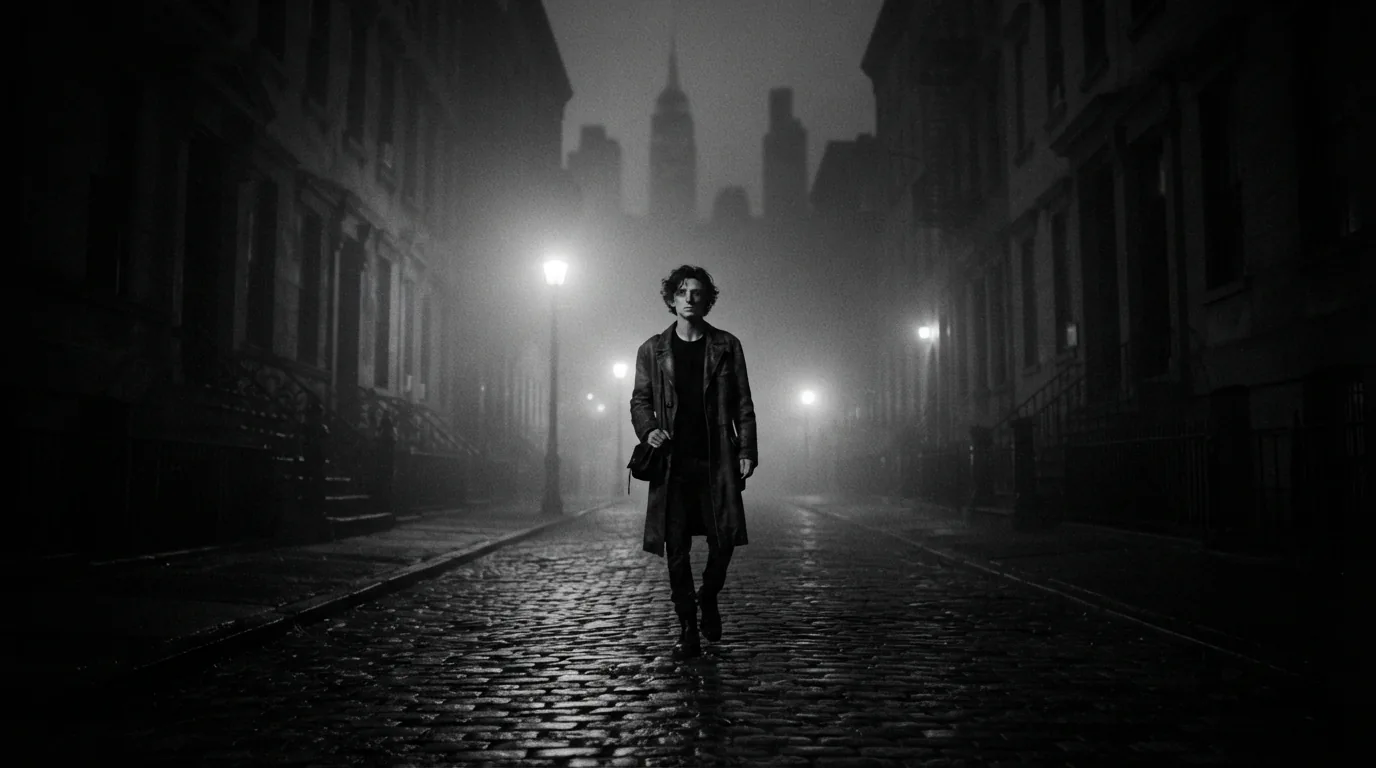
Mary Shelley’s novel is an argument about seeing: faces examined, silhouettes feared, bodies hidden and exposed, landscapes used as emotional weather. Black-and-white cinematography can make that world feel immediate rather than antique. It strips bodies and rooms down to light, texture, and attention.
In Damian Wampler’s visual development for THE MONSTER, Victor rides the Long Island Railroad beneath rain-streaked windows. The city overlays his face. In another image he draws a woman's face amid canvases that feel like a private cathedral. A dark figure can cross a bright studio without a single jump scare. There is no need for a castle lit in lurid green.
The desired aesthetic has the tender dread of an adolescent nightmare, the rich blacks of classic cinema, and the emotional styling associated with Tim Burton’s outsider romances—without claiming Burton’s involvement or reproducing anyone’s film.
Black-and-white is not an excuse to make the story inaccessible. Its purpose is to make the most important colors those the viewer invents: the blush Victor fears, the blood he cannot wash away, the golden hair the family cannot stop admiring, and the yellow eyes he refuses to meet.
Back to Mary Shelley’s 1818 text
“His limbs were in proportion, and I had selected his features as beautiful.”
What a modern adaptation can reveal
Black-and-white photography is sometimes described as a nostalgic look for horror, especially because James Whale's films established such durable monochrome imagery. For THE MONSTER the argument should be more specific. A reduced palette makes texture, contrast, reflected faces and the boundary between drawing and living flesh central to perception. It lets a page in a sketchbook and a city street belong to the same visual system. When the Creature emerges from art into reality, the camera need not announce a change of genre; it can make the two worlds look disturbingly continuous.
The film's New York setting offers a different kind of Gothic space from a castle. Subway windows double faces; nighttime streets isolate bright rectangles; apartments become layered compositions of glass, skin, paper and shadow. Color can be beautiful, but here its absence can focus attention on how Victor sees. His obsession is not a matter of making the world vivid. It is a matter of reducing people to manageable arrangements of light and form. The monochrome image can enact that reduction while quietly allowing the living bodies to resist it.
Black-and-white is not inherently serious, authentic or artistically superior. It can become a mannerism, and audiences have seen enough prestige projects whose visual austerity does little dramatic work. The design therefore has to answer practical questions: how do characters remain visually distinct; when should darkness conceal or expose; what lighting makes a face alluring before it becomes uncanny? Every major visual choice should emerge from the film's relationships, not from a mood board alone.
Whale and Mel Brooks's Young Frankenstein provide useful historical comparisons because both demonstrate the expressive possibilities of monochrome in very different registers. One helps define the classic Gothic image; the other understands that the same image can produce affectionate comedy and a mischievous erotic charge. Wampler's proposal is neither a museum reconstruction nor a parody. Its interest lies in using those inherited forms to depict contemporary youth, grief and uncertain intimacy.
A strong visual motif could be the portrait that remains still while the world changes. Victor's mother survives in an image; a male figure begins as an image; the intended female companion is denied her chance to leave an image. The film's palette binds all three acts of looking together. Black-and-white becomes a theory of power: the living have to push against the frames created for them.
Criticism and contemporary context
The Library of Congress National Film Registry provides useful background for the classic screen-image tradition. Consider how that film history shapes what audiences think Shelley wrote, then return to the novel for the differences.
For a sense of the wider contemporary genre landscape, consult Rotten Tomatoes’ 2026 horror preview. It is an overview of varied releases, not evidence that any single style is commercially guaranteed. The relevant lesson is the space for distinct tones and audiences.
Editorial context. This is original analysis associated with the development of Damian Wampler’s screenplay THE MONSTER, inspired by Mary Shelley’s public-domain novel. Interpretive claims are presented as readings; named films and actors are not affiliated with the project.