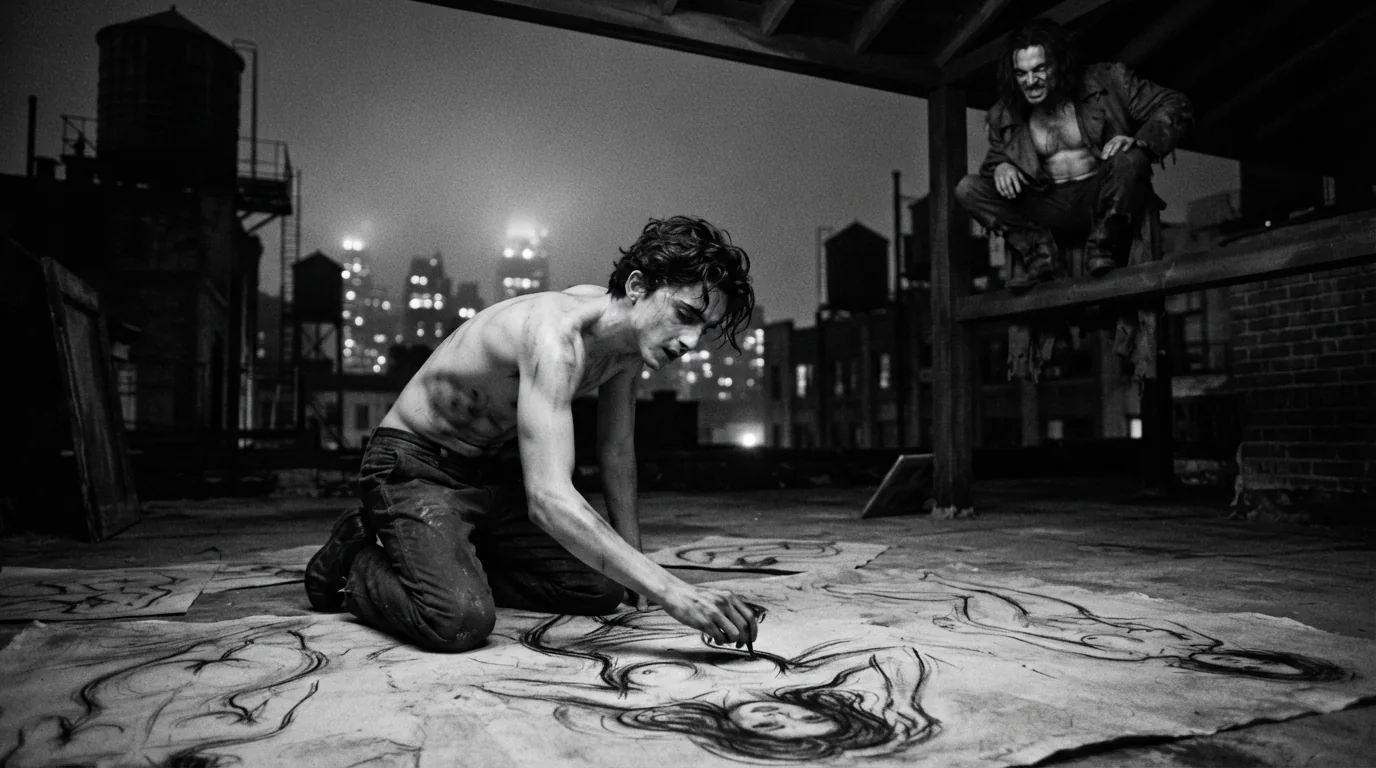
There is a reason the story keeps returning. Every generation finds a new machine to blame for the Creature: electricity, laboratories, bioengineering, artificial intelligence. Those machines change. The questions beneath them remain alarmingly personal. What does a parent owe the child they chose to make? How does wealth turn generosity into dependence? What part of ourselves do we banish when it refuses to conform?
Damian Wampler’s THE MONSTER answers by refusing the familiar shape of a middle-aged scientist standing above a slab. The hero is a troubled young artist. The setting is modern New York. The Creature is beautiful, terrifying, and physically intimate. Henry Clerval and Justine are important people rather than missing pages in a condensed script. The woman who never lives matters as much as the one Victor is expected to marry.
The story’s transformations are overt. Its loyalties are to the wounds in Shelley’s structure: the family formed through class hierarchy, the lonely boy at university, the secret labor of making a man, the rejected creation, the withheld companion, and the dreadful arrival at the wedding night.
The Monster is a new feature screenplay seeking producing, financing, casting, and distribution partners. Its boldest proposition is that there is still a Frankenstein movie capable of surprising people who think they already know the story.
Back to Mary Shelley’s 1818 text
“I ought to be thy Adam; but I am rather the fallen angel, whom thou drivest from joy for no misdeed.”
What a modern adaptation can reveal
Two centuries of adaptations have not exhausted Frankenstein because the novel is not reducible to a plot device. Life is made, abandoned and pursued; that much can be repeated indefinitely. The staying power comes from the morally incompatible claims lodged inside the event. A creator has frightening powers and genuine remorse. The Creature possesses intelligence, suffering and the capacity for violence. Women become the objects of promises they did not negotiate. Friends and servants pay for the choices of a privileged young man. No single retelling can render every tension equally visible.
The current appetite for gothic horror is often discussed as though a fresh costume or new technological metaphor would be enough. Contemporary film culture is actually a wide range of approaches, from highly stylized historical horror to intimate stories about grief, embodiment and relationships. The 2026 horror-film conversation demonstrates continued genre variety, not a simple demand for one fashionable subgenre. A new Frankenstein must offer an artistic reason to exist, and that reason should be evident in character and form long before the marketing campaign explains it.
Damian Wampler's screenplay offers one such argument through art instead of science. Victor makes a man by drawing; his created being is beautiful; the event becomes entangled with sexuality, shame and social privilege. This is a creative departure from Shelley at the level of mechanism, but it returns to the novel's intense focus on intention, recoil and the ethical consequences of abandonment. The experiment matters less as a demonstration of plausibility than as a test of the person who undertakes it.
Scholarly disagreement helps the work remain alive. Queer criticism, feminist analysis, class readings and research into the 1818 and 1831 versions do not cancel one another out. They ask different questions of a text capacious enough to sustain them. A director can choose one emphasis while giving enough emotional detail for other meanings to remain present. The alternative is a film that offers a single thesis, solves it, and leaves nothing for viewers to think about after the credits.
The most promising future Frankenstein film may be one that refuses to end the argument. It can leave viewers troubled by a beautiful Creature they cannot fully excuse, a sympathetic creator they cannot absolve, and a household that calls itself loving while devastating those with the least power. If an audience emerges divided about where responsibility begins and ends, the film will be doing something close to what the novel has done for generations.
Criticism and contemporary context
For the primary-text distinction, the Frankenstein Variorum project explains why the two major editions should be compared rather than quietly merged. Read the original source before treating a character’s changing biography as a fact that all adaptations necessarily share.
The 2026 horror-film roundup shows the breadth of critical and audience conversations. Rather than copying whatever title is fashionable this month, a Gothic adaptation can define a recognizable point of view that remains interesting after its initial release.
Editorial context. This is original analysis associated with the development of Damian Wampler’s screenplay THE MONSTER, inspired by Mary Shelley’s public-domain novel. Interpretive claims are presented as readings; named films and actors are not affiliated with the project.