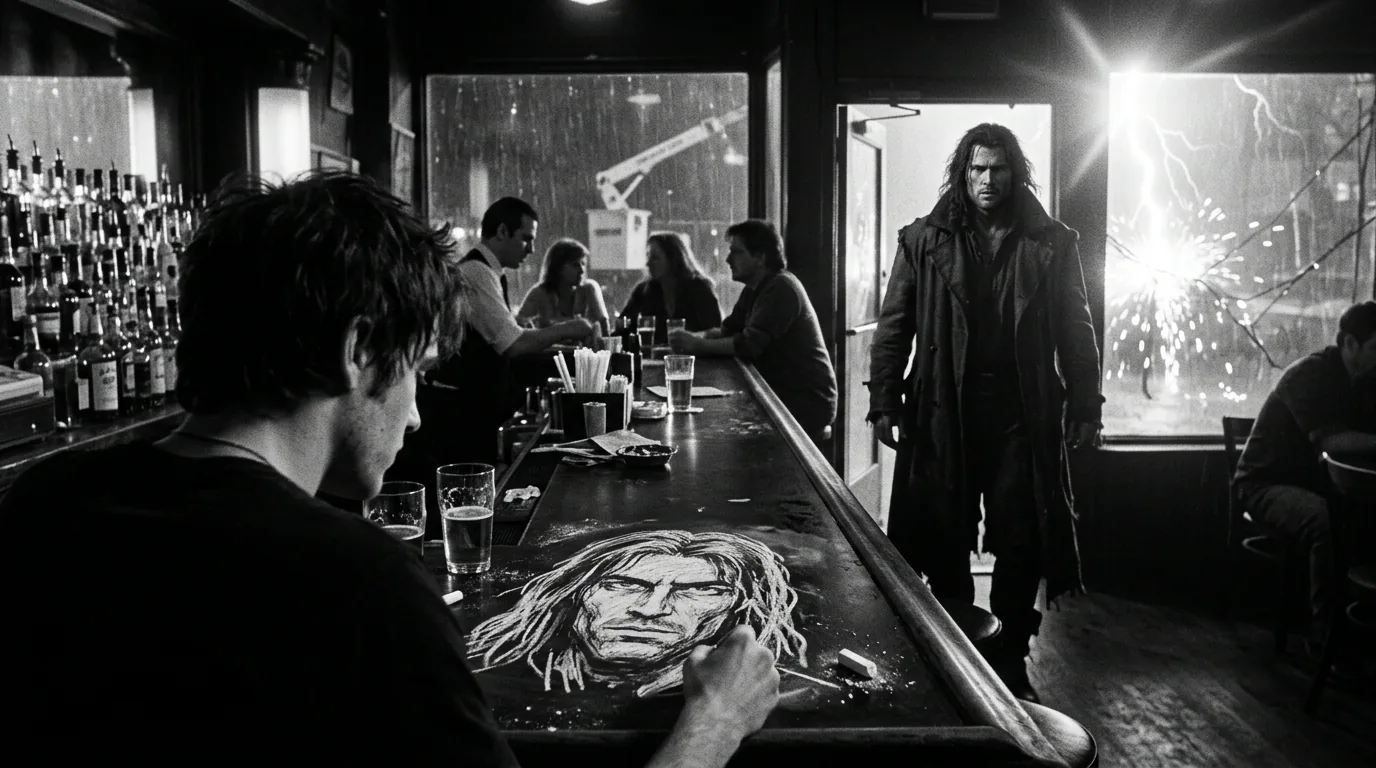
Mary Shelley begins with a wealthy young man who wants to command the boundary between life and death. Then the man he brings into the world looks back at him. Victor recoils. The terrible act is not the achievement of creation; it is the speed with which an ambitious father disowns the person for whom he is responsible. Shelley builds a novel in which a privileged man can cause catastrophe and still spend pages describing his suffering.
Damian Wampler’s screenplay THE MONSTER preserves that moral reversal. Its Victor is eighteen, leaving a comfortable Long Island family for New York City with a paintbrush and a head full of grief. The supernatural method is new: a young artist makes a man through drawing. The old ethical failure is intact. The image moves, breathes, wants something, and Victor cannot accept what he has done.
This is not the usual 'mad scientist makes monster' picture. It is a story about the arrogance of authorship. An artist creates a living person and then treats him as a mistake that can be erased. The young audience invited into this nightmare may recognize a familiar dynamic: people who want the power to define you but none of the responsibility of loving you.
The film asks who deserves the title. The being made from a drawing—or the maker who can only love what does not answer back?
Back to Mary Shelley’s 1818 text
“No father could claim the gratitude of his child so completely as I should deserve their’s.”
What a modern adaptation can reveal
A film that calls Victor the monster should not mean that the Creature has become harmless. The stronger claim is that Victor's ordinary appearance, education, inherited wealth and self-image allow him to harm others while remaining recognizable as the story's presumed protagonist. He is capable of love and terror, but he treats his internal suffering as an explanation that should rearrange everyone else's obligations. The horror comes from how plausible his evasions sound. He is always a moment away from accepting responsibility, and the moment rarely arrives in time.
Shelley's Victor imagines future beings honoring him as their creator. The fantasy is revealing because it substitutes guaranteed gratitude for a real relationship. He wants descendants without the labor of parenthood and recognition without vulnerability. Once the Creature becomes independent, Victor cannot tolerate the unpredictability of another person's need. His failure is therefore not a lack of genius; it is a refusal to participate in the social life that his act has made unavoidable.
The wealthy household amplifies that refusal. Victor's mistakes are first managed as private disasters, then as legal and familial emergencies whose costs fall onto others. Justine is condemned; Clerval is killed; Elizabeth faces a marriage burdened by secrets; the father must deal with the destruction of his family's imagined future. The Creature bears responsibility for violence, but Victor cannot claim that another being's choices cancel the consequences of his original abandonment. The two forms of culpability exist together, which is why the story resists an easy villain swap.
Hammer's 1957 film, with Peter Cushing as a ruthlessly controlled Baron, offered one powerful cinematic account of patriarchal monstrosity. Wampler's young artist is a different version: fragile, desirable, confused and still morally dangerous. The comparison is useful because it separates cruelty from its most obvious physical signs. A terrifying Victor might not command a castle or wear a bloody coat. He might be a boy who cannot say the truth in a room full of people who trust him.
The film's final image of Victor and the Creature falling together can make their dependence visual. The created being will not leave him, and the creator cannot escape what he has made. Their struggle has consumed the people who might have offered a different future. The last question for the audience is not which face looks monstrous. It is which acts of care were possible and repeatedly refused.
Criticism and contemporary context
Anca Vlasopolos’s study of oppression in Frankenstein provides a critical counterweight to readings concerned only with individual ambition. It helps explain why domestic affection, social position and the right to be believed matter within the horror story.
A 2026 article in Adaptation compares screen versions through the Creature’s ethical status. That approach keeps the discussion away from trivia about matching details and closer to the matter of whose experience cinema asks its viewers to understand.
Editorial context. This is original analysis associated with the development of Damian Wampler’s screenplay THE MONSTER, inspired by Mary Shelley’s public-domain novel. Interpretive claims are presented as readings; named films and actors are not affiliated with the project.