The most familiar Frankenstein adaptations begin too late. We meet Victor already obsessed, already competent enough to be dangerous, and already sheltered by a rich family whose origin is treated as unimportant wallpaper. But Shelley opens her family history with a different kind of monster story: bankruptcy, grief, guardianship, and a marriage born in unequal conditions.
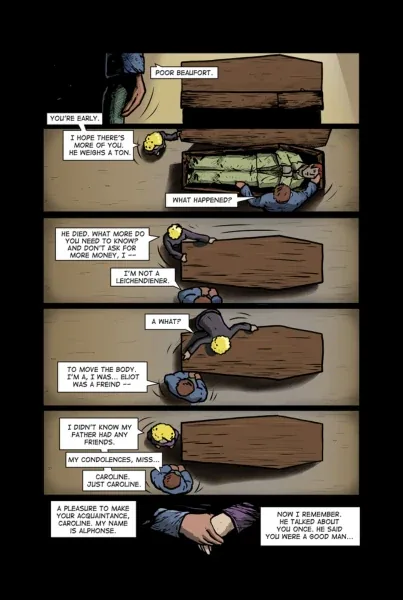
GUTTERS began as Damian Wampler’s unpublished graphic treatment of that origin. Ten story pages use frames, silence, and stark changes of perspective to ask what it means to rescue someone when the rescuer also has the power to define the future.
As a limited-series premise, it could follow Caroline and Alphonse before the famous experiment. Each episode would investigate a different face of benevolence—an offer of shelter, an obligation of gratitude, a family arranged around one man’s idea of happiness. A young Victor could enter only near the end, inheriting a house already filled with ghosts.
The feature THE MONSTER and the GUTTERS prequel share a critical philosophy without requiring audiences to consume both. Each asks how the desire to create or protect a family can turn into the desire to own it.
Back to Mary Shelley’s 1818 text
“A new species would bless me as its creator and source; many happy and excellent natures would owe their being to me.”
What a modern adaptation can reveal
A comic and a screenplay can inhabit one artistic project without pretending to be interchangeable forms. The page can dwell on an image, guide the reader through composition and let a pause last as long as the reader needs. Film controls duration, movement, performance and sound. THE MONSTER uses both possibilities: the graphic prehistory of Gutters establishes a family system while the feature builds the experience of a young artist who creates a living man. The connective tissue is not just continuity of characters. It is the attention to looking, possession and the bodies that affluent families arrange into beautiful pictures.
The apparent paradox is that Frankenstein became a modern franchise long before anyone used that industrial word. The Creature moved from novel to theater, film, parody, comic art and popular merchandise; each incarnation left images that later versions borrowed. A new graphic narrative joins that long migration. It can be judged on its own terms while acknowledging the original 1818 novel that makes the experiment possible. The important thing is to be transparent about what belongs to Shelley, what belongs to later adaptations, and what is newly invented.
Gutters reaches backward to the class history of Alphonse and Caroline. The feature moves forward into art school, erotic uncertainty, law enforcement and a modern wealthy family. The chronology is not merely a marketing opportunity. It lets two stories ask different versions of the same question: when does kindness become an exercise of control? One can investigate the parents' social ascent while the other shows the son seeking a still more radical form of authority over another life.
The comic form is especially effective at displaying how the family wants to be seen. A panel creates a border, and a border tells the viewer which bodies are included. The neglected person can remain in the gutter between panels as effectively as in the literal streets of the narrative. Film can invert that arrangement by bringing a carefully designed drawing to life and allowing the figure to move beyond the boundaries his creator imagined. One medium is about the frame; the other is about its rupture.
The danger for any shared creative universe is that worldbuilding becomes an end in itself. A reader does not need to study continuity notes to care about Caroline, and a filmgoer should not need the comic to understand Victor. Each work must offer a complete emotional experience. Their real strength as companion pieces is that they illuminate one another's blind spots without requiring the audience to treat either one as homework.
Criticism and contemporary context
For the primary-text distinction, the Frankenstein Variorum project explains why the two major editions should be compared rather than quietly merged. Read the original source before treating a character’s changing biography as a fact that all adaptations necessarily share.
Anca Vlasopolos’s study of oppression in Frankenstein provides a critical counterweight to readings concerned only with individual ambition. It helps explain why domestic affection, social position and the right to be believed matter within the horror story.
Editorial context. This is original analysis associated with the development of Damian Wampler’s screenplay THE MONSTER, inspired by Mary Shelley’s public-domain novel. Interpretive claims are presented as readings; named films and actors are not affiliated with the project.