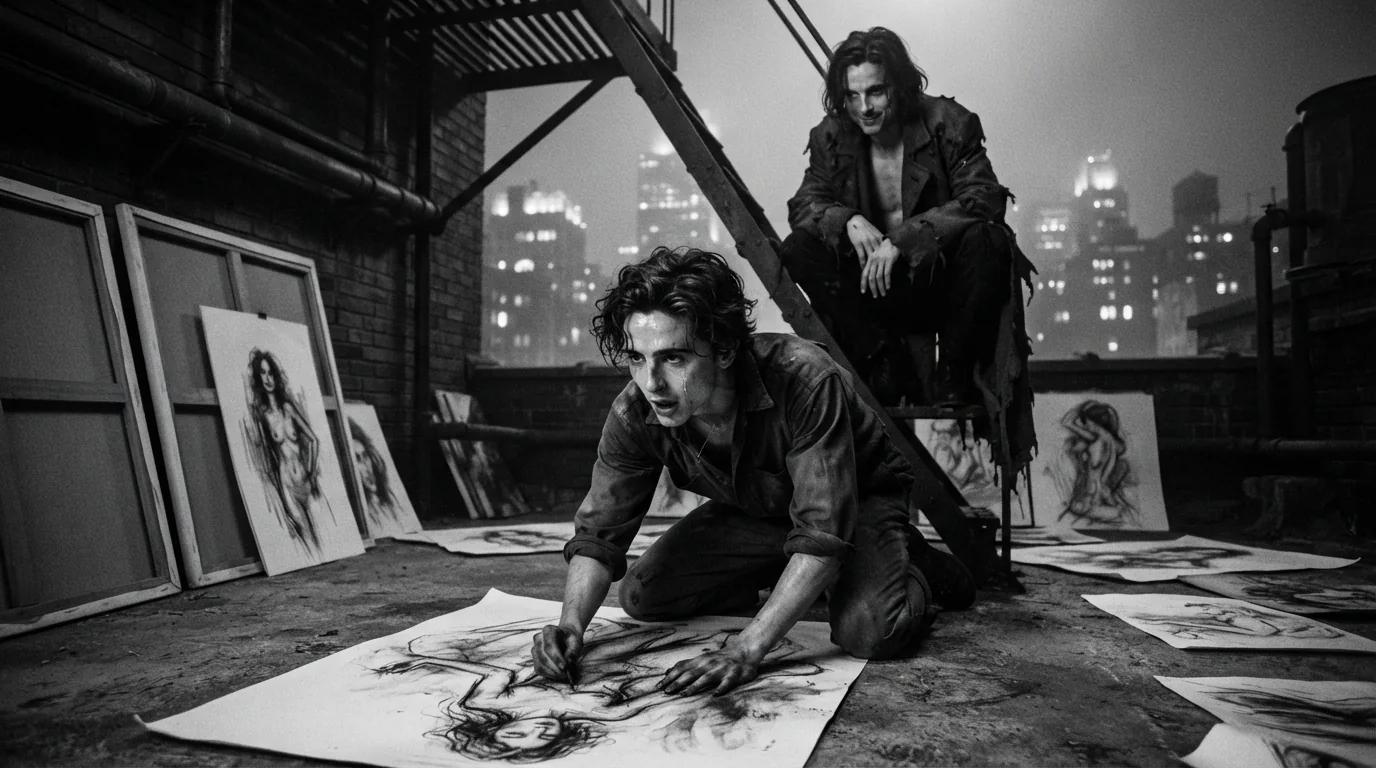
The novel says Victor labors almost two years. That time is crucial. Creation is not an electrical accident. It is sustained labor, physical isolation, withdrawal from friends, and an obsession allowed to become the architecture of a life. Frankenstein’s most frightening rooms are not laboratories: they are rooms someone has stopped leaving.
Damian Wampler’s adaptation translates the obsession into painting and sketching. Victor’s canvases begin with landscapes, then figures, then nude studies. An art professor encourages risk. Victor does not spend a weekend flipping a switch. He spends two years losing himself to images of bodies until one startlingly handsome man steps out of a sketch in a bar.
The paradox is not that Victor fails to recognize the sex of the being he makes. He has pictured it again and again. The shock is that the body he imagined is a subject, not an object. It can look at him, touch him, choose him, demand an answer. A room of drawings becomes a room full of consequences.
In that instant the visual language of the film turns from romantic urban isolation to stalking horror. THE MONSTER wants the audience to feel that the creation has been coming for two years, and Victor has known all along.
Back to Mary Shelley’s 1818 text
“I had worked hard for nearly two years, for the sole purpose of infusing life into an inanimate body.”
What a modern adaptation can reveal
The figure of two years has unusual force in Frankenstein because it turns creation from a single impossible trick into an extended occupation. Victor withdraws from health, ordinary society and family contact to complete his work. During that time he is not simply waiting for an invention to succeed; his whole life is reorganized around an object of extraordinary attention. A film should treat the duration as psychological evidence. What does someone neglect when every day is dedicated to making one person who must embody his idea of perfection?
A montage of hands, sketchbooks, unfinished canvases and a room slowly filling with images can be much more intimate than a montage of experiments. The viewer sees the work becoming an obsession long before anything supernatural happens. In Wampler's screenplay the image of a beautiful male figure concentrates the question of desire. The artist has sustained a gaze for two years; the emerging person will eventually return that gaze. The prospect of reciprocity, rather than the technical success itself, becomes frightening.
The date also links creation to young adulthood. Two years is a substantial portion of an eighteen-year-old's life. Friends change, relationships require effort, courses end, families expect visits, and a person learns how to occupy the world beyond his childhood home. Victor's chosen isolation means that by the time he succeeds, he has failed at many ordinary processes of becoming an adult. His achievement is not a separate triumph followed by an accident; it is the culmination of a pattern of self-erasure.
Shelley's prose describes the beauty of the dream disappearing immediately when the Creature awakens. This is the emotional hinge. The maker has loved the project, perhaps even the imagined body, but he cannot accept the real being who depends on him. The distinction between loving one's work and loving the life one's work creates is devastating. It is why the creation scene must allow the audience to linger on Victor's reaction rather than rush toward a chase or a laboratory explosion.
The two years also raise a question of artistic ethics recognizable today: do makers owe anything to the people or communities affected by what they produce? A fictional living drawing is obviously unlike a film or an image-generating tool, but the structure of the question is useful. The fantasy of total authorship gives way to an encounter with people who have claims of their own. That is when creation becomes responsibility.
Criticism and contemporary context
Mair Rigby’s account of Frankenstein’s queer Gothic is a starting point for interpreting desire without confusing an interpretation with a definitive statement about Shelley’s private intentions. Such research rewards close attention to what the characters cannot say.
For the primary-text distinction, the Frankenstein Variorum project explains why the two major editions should be compared rather than quietly merged. Read the original source before treating a character’s changing biography as a fact that all adaptations necessarily share.
Editorial context. This is original analysis associated with the development of Damian Wampler’s screenplay THE MONSTER, inspired by Mary Shelley’s public-domain novel. Interpretive claims are presented as readings; named films and actors are not affiliated with the project.