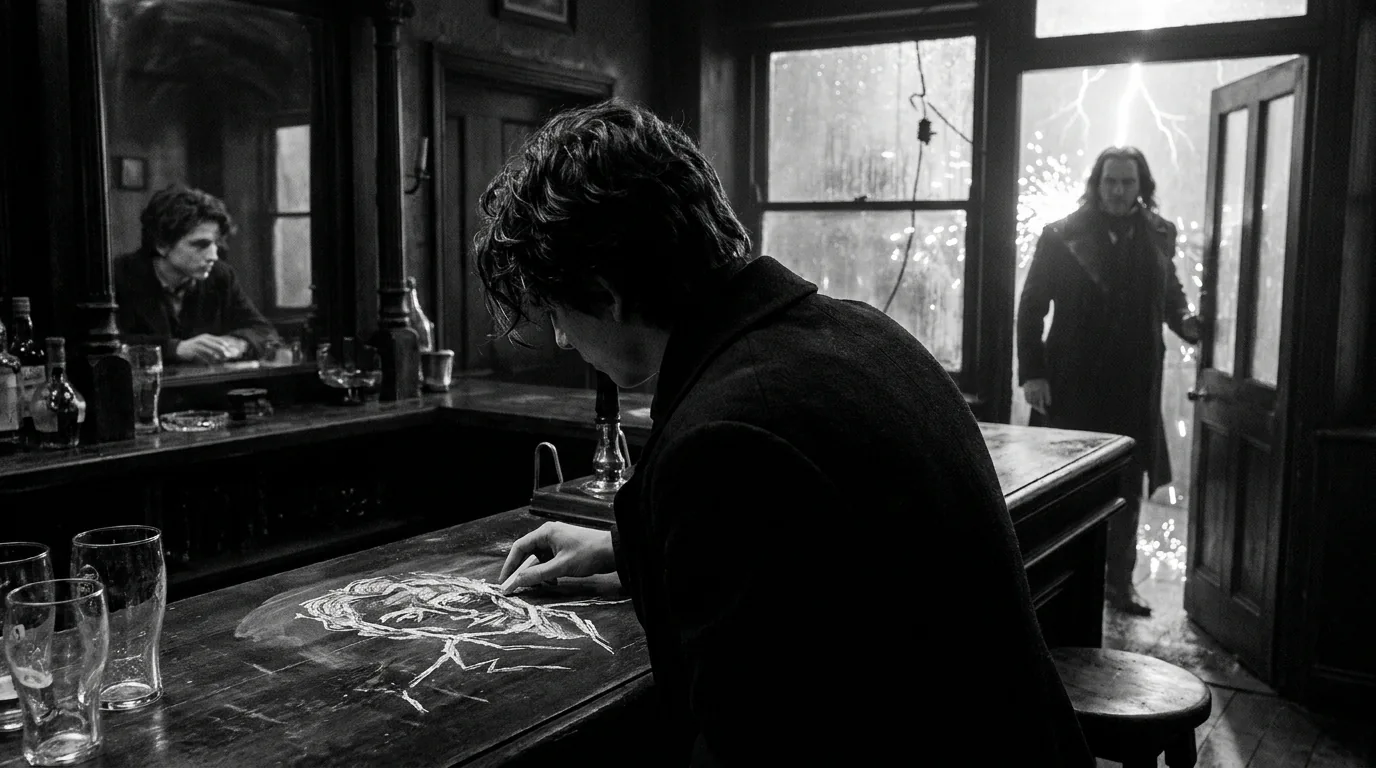
A threat at the threshold of marriage is one of the novel’s most devastating choices. The Creature promises Victor that he will be present on the wedding night. Victor fears he himself will be attacked, while Elizabeth is the person in danger. That failure of interpretation is both a plot engine and a window onto Victor’s mind.
Damian Wampler offers a deliberately provocative reading: the male Creature figures an intimacy Victor has attempted to bury. As the wedding requires him to perform his future as a husband, the secret arrives in bodily form. The threat is not proof that Shelley intended a straightforward gay allegory; it is an interpretive possibility supported by a history of queer literary criticism.
The screenplay literalizes the unease through nightmares, mirrors, misplaced touch, and a kiss Victor cannot assimilate. The Creature can appear where Victor expects Elizabeth to be. He arrives at the one ritual meant to make Victor’s relationship publicly legitimate. Horror and desire suddenly speak the same visual language.
The challenge is to leave the audience uncertain. Is Victor frightened of the Creature, frightened of wanting him, or frightened of losing the life constructed for him by his family? An urgent young Gothic movie can ask all three questions at once.
Back to Mary Shelley’s 1818 text
“I shall be with you on your wedding-night.”
What a modern adaptation can reveal
The wedding-night threat is one of Shelley's most brilliant narrative traps. The Creature tells Victor he will be present at the wedding; Victor interprets the statement as a prediction of his own death. The reader subsequently discovers the deadly error in that assumption. Victor has imagined himself as the center of the danger, once again overlooking the vulnerability of the woman he intends to marry. The plot mechanism is simple, but its emotional implications reach into secrecy, intimacy, and the consequences of letting someone else remain ignorant of a threat.
A queer interpretation can read the wedding as the socially required performance of heterosexual adulthood. Victor's secret relationship with the being he has made returns precisely when he is expected to become a husband. The Creature's appearance threatens not merely the ceremony but the clean division between private desire and public family life. This reading is supported by a wider tradition of queer Gothic criticism, but it need not exclude the more literal dramatic situation: a bereaved creator is haunted by an enemy who intends revenge.
Elizabeth's tragedy must remain her own. The threat works because she is not given the information necessary to judge her danger. Victor imagines his own death, keeps his secret, and proceeds with the marriage. In the film, making her a perceptive person who recognizes the distance growing between them would deepen that injustice. She need not know about the Creature to know something essential is being withheld. The wedding then becomes suspenseful before the external danger arrives.
Wampler's modern setting can bring the contradiction into contemporary images: a carefully photographed celebration, the clothing and rituals of a wealthy family, and a groom whose face reveals dread rather than anticipation. The horror is not that marriage itself is a punishment, but that two people have been pushed toward a ceremony that cannot resolve the problems they refuse or are forbidden to discuss. A camera can turn the ideal social image into a frame of confinement.
The crucial question is what Victor believes the Creature has promised to do, and why that interpretation seems so easy to him. His narcissism and fear make him misread the danger; Elizabeth pays. The finale becomes a tragedy of failed attention. He was warned, but he listened as though the only life under threat was his own.
Criticism and contemporary context
Mair Rigby’s account of Frankenstein’s queer Gothic is a starting point for interpreting desire without confusing an interpretation with a definitive statement about Shelley’s private intentions. Such research rewards close attention to what the characters cannot say.
In Emily Wotherspoon’s research on Elizabeth and Justine, the shrinking space granted to women across adaptations becomes a central artistic problem. That perspective is useful whenever a screen version gives its male creator complexity while leaving the women around him as consequences.
Editorial context. This is original analysis associated with the development of Damian Wampler’s screenplay THE MONSTER, inspired by Mary Shelley’s public-domain novel. Interpretive claims are presented as readings; named films and actors are not affiliated with the project.