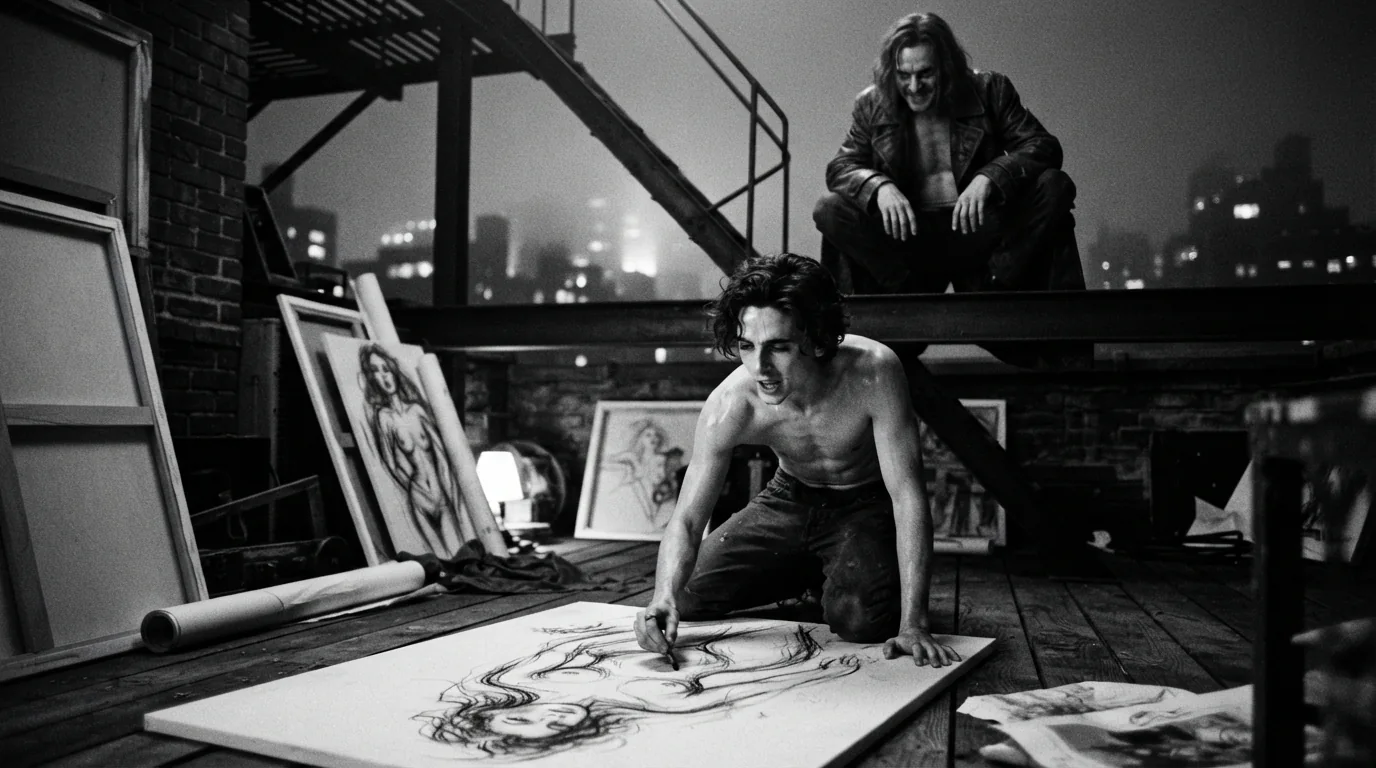
No bolt-necked figure strapped to a gurney. No switch thrown during a thunderstorm. In THE MONSTER, Victor sketches a face and meets its gaze in the flesh. This is a radical change to the method of creation, and the website is explicit about it. Damian Wampler is not claiming that Mary Shelley wrote an art-school film set in New York City.
But the change renews the original question. A portrait is an act of selection: the artist decides whose features matter, which lines should be softened, and which imperfections should be kept outside the frame. A living portrait refuses such control. Victor is no longer its only author.
The artistic conceit also puts the young creator’s desire in plain view. He has made the body he wanted to draw. When that body becomes human, the romance of looking becomes the panic of being looked at. This is a natural foundation for a queer reading without a clinical label or a compulsory answer about Victor’s orientation.
For an audience raised on images, avatars, filters, and carefully managed self-presentation, the idea is immediate: What if the image you made could ask why you were ashamed of it?
Back to Mary Shelley’s 1818 text
“A new species would bless me as its creator and source; many happy and excellent natures would owe their being to me.”
What a modern adaptation can reveal
A laboratory tells an audience to expect questions about scientific power, institutional oversight and the material mechanics of making life. An artist's studio shifts attention toward desire, likeness, beauty and the way an image can seem to contain another person's essence. The difference is not that art is morally pure while science is dangerous. It is that both can become languages through which a creator imagines authority over something that will exceed him. Making Victor a visual artist opens emotional material that a conventional sequence of electrical machines might leave hidden.
In Shelley's novel the exact technical procedure is subordinate to its aftermath. Victor's imagination transforms a living body into an achievement he expects to admire, then into a horror he cannot bear. The novel's artistic vocabulary—form, features, proportions, beauty—is already present in his description. A contemporary adaptation can take those words literally. A figure on paper becomes a man who can speak back to the person who designed him. The change keeps the central ethical dilemma while creating an unfamiliar and cinematic first encounter.
The visual strategy is rich without demanding a huge effects budget. A hand studies a line; a stranger resembles a drawing; the distinction between the sketchbook and the city begins to fail. Sound can introduce uncertainty before a spectacular reveal is necessary. The crucial scene is between two actors, because the miracle is not simply animation. It is the transfer of control from the maker's hand to the life the maker did not anticipate having to care for.
This premise also allows an exploration of sexuality without requiring a definitive reading of the character. An artist who repeatedly draws an alluring male body may be wrestling with desire, fear, grief, ambition or a need to master human form. The audience can see the contradiction between aesthetic attention and interpersonal refusal. Mair Rigby's queer Gothic scholarship is useful as one lens, while class and feminist readings provide others. The film succeeds when the formal invention generates a plurality of meanings rather than functioning as a clever gimmick.
An artist instead of a scientist is not a claim to be more faithful in every respect. It is a candid, significant adaptation. Its value should be judged by whether the new mechanism returns the audience to Shelley's most unsettling question: what does the creator owe to a life that becomes more than the object of creation?
Criticism and contemporary context
For a sense of the wider contemporary genre landscape, consult Rotten Tomatoes’ 2026 horror preview. It is an overview of varied releases, not evidence that any single style is commercially guaranteed. The relevant lesson is the space for distinct tones and audiences.
Mair Rigby’s account of Frankenstein’s queer Gothic is a starting point for interpreting desire without confusing an interpretation with a definitive statement about Shelley’s private intentions. Such research rewards close attention to what the characters cannot say.
Editorial context. This is original analysis associated with the development of Damian Wampler’s screenplay THE MONSTER, inspired by Mary Shelley’s public-domain novel. Interpretive claims are presented as readings; named films and actors are not affiliated with the project.