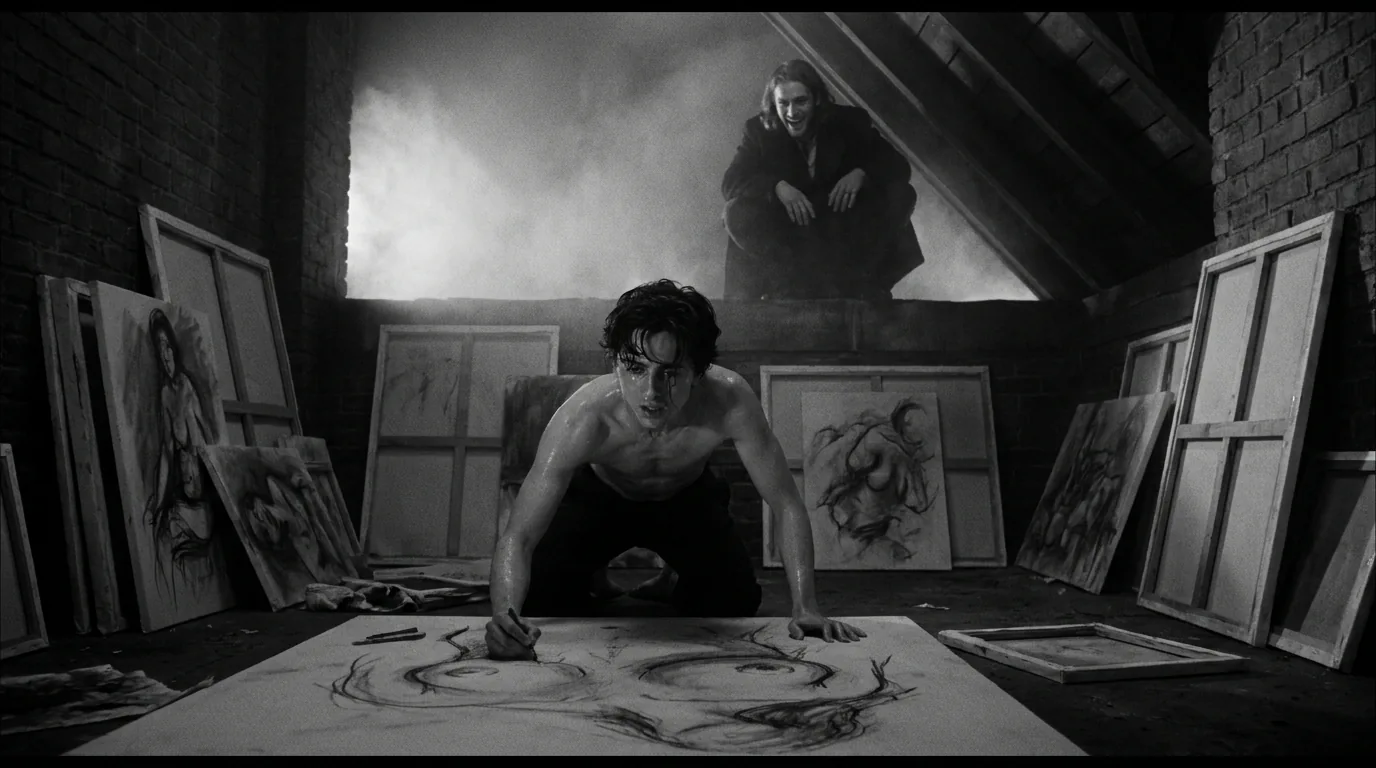
Victor is often played by men old enough to have finished several careers. That choice changes the psychology of the story. In Shelley’s novel Victor leaves home for university as a young man; his great transgression belongs to the dangerous interval when a person is brilliant enough to believe he is omnipotent and inexperienced enough to believe he can escape consequences.
THE MONSTER puts an eighteen-year-old Victor on a Long Island Railroad train. He is dark-haired, withdrawn, dressed like an emo art student rather than a doctor. The script opens with an image of a young man staring through the window while reflections of the city swallow his face. New York is liberation and exile at the same time.
This age opens an emotional register often missing from the prestige adaptation: first love, loyalty to a best friend, competitive art-school ambition, terror of adult intimacy, and the dread of becoming someone your family cannot understand. Victor is not an elder statesman of science. He is a boy making irreversible choices.
Damian Wampler’s casting vision begins with Timothée Chalamet as a target, not an attachment, because the role needs intelligence, hunger, beauty, nervous energy, and the possibility of genuine collapse.
Back to Mary Shelley’s 1818 text
“Learn from me, if not by my precepts, at least by my example, how dangerous is the acquirement of knowledge”
What a modern adaptation can reveal
Age changes the moral temperature of a scene. A middle-aged Victor confronting the results of an experiment suggests settled ambition turning monstrous. An eighteen-year-old Victor can be brilliant and utterly inexperienced: old enough to make a consequential choice, young enough to lack the habits needed to live with it. Shelley sends Victor to university as a young man whose confidence and absorption outrun his judgment. The film's decision to place him at eighteen makes adolescence and the fear of adulthood formal parts of the horror, not a concession to youth-oriented casting.
New York is useful precisely because it supplies so many opportunities for ordinary connection. A train can carry Victor through crowds while keeping him alone; a studio can hold bodies drawn with attention while the artist avoids the people attached to them. This is not the same isolation as a castle on a mountain. Urban solitude is lived among witnesses, trains, screens, rent, classes, parties, and the pressure to construct a self. For Victor, that pressure becomes the power to construct someone else. The city offers a thousand ways to belong, and he invents a person instead.
An adolescent protagonist also complicates the film's sexual subtext. Confusion about attraction, responsibility, status and parental expectation may coexist without forming a single answer. Victor can desire the image he draws and still be frightened when that image asks him to relate to a real man. The story need not diagnose him or attach a fixed identity label. A film about becoming an adult can dramatize the cruelty of refusing one's own feelings when another person bears the cost.
The casting vision of Timothée Chalamet belongs to the realm of proposed, unattached casting. Its dramatic logic is recognizable: a performer must suggest concentration, beauty, contradictory appetites, and a collapse from nervous vitality into self-protective silence. The challenge is not to make Victor innocent because he is young. It is to make the audience understand how an appealing young person learns to outsource the consequences of actions that he insists are uniquely his.
A younger protagonist gives the final pursuit a particularly bleak resonance. This was supposed to be the period when Victor encountered the world, made friends and acquired independence. Instead he spends his emerging adulthood chasing a life he brought into existence and rejected. The film becomes a perverse coming-of-age story: he learns what he is only after nearly everyone who loved him has been destroyed.
Criticism and contemporary context
The side-by-side discussion of the 1818 and 1831 texts makes the underlying textual choices inspectable. A screen adaptation may select or alter those details, but criticism becomes more persuasive when it names the source version it is using.
For a sense of the wider contemporary genre landscape, consult Rotten Tomatoes’ 2026 horror preview. It is an overview of varied releases, not evidence that any single style is commercially guaranteed. The relevant lesson is the space for distinct tones and audiences.
Editorial context. This is original analysis associated with the development of Damian Wampler’s screenplay THE MONSTER, inspired by Mary Shelley’s public-domain novel. Interpretive claims are presented as readings; named films and actors are not affiliated with the project.