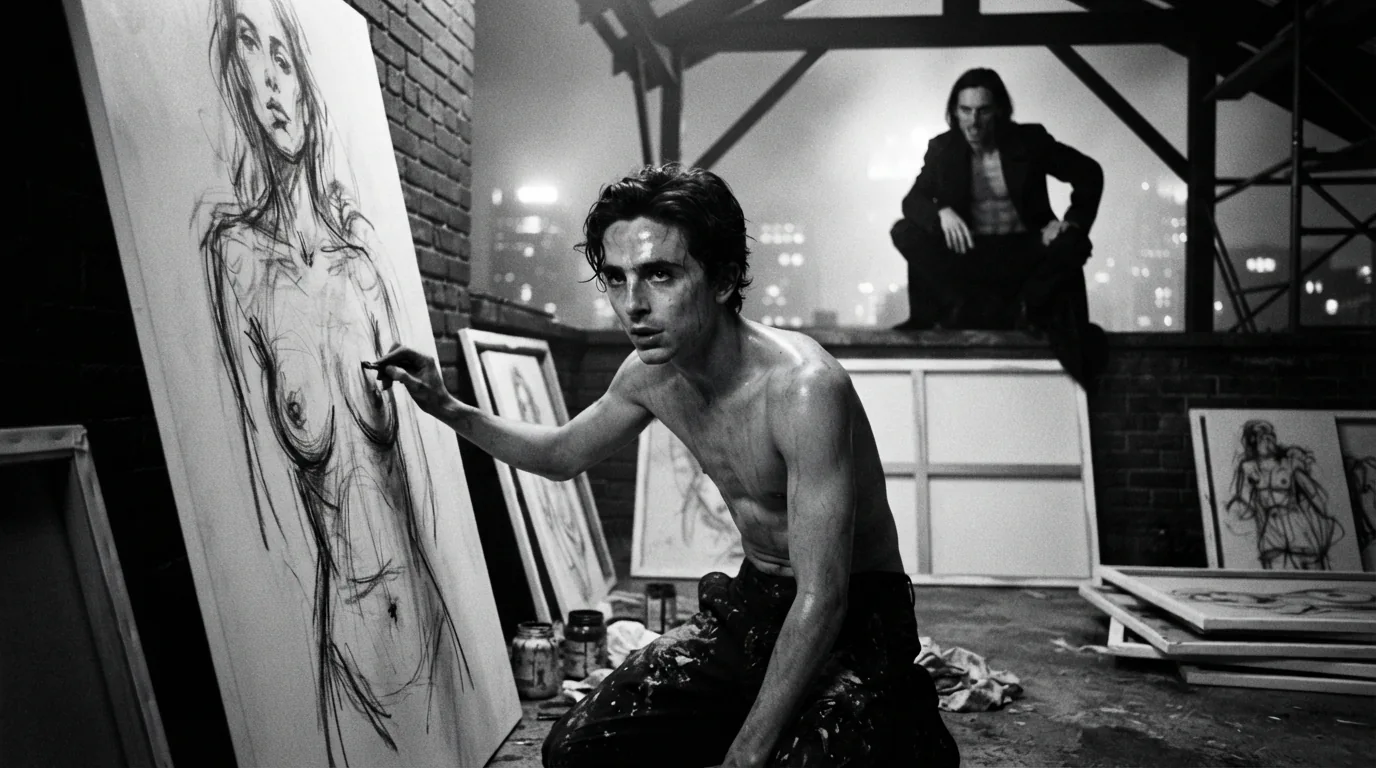
The distinction is simple but enormous. The Creature asks Victor for a companion in Shelley’s novel. Victor agrees, travels, and begins the work. Only after constructing much of the second being does he destroy her. He acts against the promise he made and against the possible life of a woman who cannot argue her case.
Guillermo del Toro’s 2025 adaptation does not stage that nearly completed female creation. In that film Victor refuses rather than slowly changing his mind while building her. The omission takes the story away from one of its starkest arguments about women, reproductive control, and the creator’s power to preempt another person’s choice.
Damian Wampler’s THE MONSTER uses the image of a painting that approaches life. The Creature’s longing is real, but his demand that a woman exist for his sake is also troubling. Victor’s refusal to animate her can be defensible as fear of harm and indefensible as a unilateral denial of agency. The film should make both responses available.
An adaptation need not include every event. But deleting this one deletes a question no amount of production design can replace.
Back to Mary Shelley’s 1818 text
“I am alone, and miserable; man will not associate with me; but one as deformed and horrible as myself would not deny herself to me.”
What a modern adaptation can reveal
Guillermo del Toro's 2025 Frankenstein is so visually complete that it can feel like the whole myth. Yet the film does not stage the unfinished female companion in the form that makes the episode so disturbing in Shelley's novel. The distinction is crucial. The female Creature is not simply a second monster whose absence lowers the body count. She is an imagined woman whose right to exist is discussed by two men and then revoked by one of them. The absence of that scene removes one of the source text's most pointed questions about reproductive authority and female autonomy.
It is tempting to frame such an omission as an accusation against del Toro. That would be unfair and critically unproductive. His film chooses a different emotional thesis, centering the wounds of the father-son relationship and the Creature's desire to be loved. An adaptation cannot preserve every interpretive possibility. What a new filmmaker should do is identify the space left open by those choices. In this case, the missing companion offers a powerful way to connect male creation, fear of women's agency and the desire to control the future.
The novel's scene depends on Victor imagining things the female being might do rather than reacting to what she has done. She might refuse her intended companion; she might become destructive; she might reproduce. His fear masquerades as a reasoned forecast. This is the political structure of the scene: a prospective person is denied the chance to choose because a man with power is terrified of possible future choices. A camera held on an unfinished female portrait could make the argument with little spectacle.
Emily Wotherspoon's research on the marginalization of women in Frankenstein's adaptation history helps explain why omissions of this kind matter beyond plot comparison. Women in the source are frequently converted into romantic destinations or casualties. The never-animated woman is a special case because the story does not even grant her those limited roles. She is the erased possibility of female life itself, an uncomfortable image for an audience accustomed to expecting a spectacular Bride reveal.
The new film's task is not to repair del Toro's work. It is to occupy a different artistic argument. The destroyed portrait can become one of the most frightening scenes in THE MONSTER because nothing attacks Victor. He looks at something he could bring into existence, thinks about the freedom it might exercise and chooses destruction. That is a horror story about power, not just a missing chapter of a familiar legend.
Criticism and contemporary context
Jodie Marley’s January 2026 discussion for the British Association for Romantic Studies is useful for distinguishing inherited Gothic material from a recent adaptation’s new dramatic relationships. The changes are worth understanding, not simply scoring as mistakes.
In Emily Wotherspoon’s research on Elizabeth and Justine, the shrinking space granted to women across adaptations becomes a central artistic problem. That perspective is useful whenever a screen version gives its male creator complexity while leaving the women around him as consequences.
Editorial context. This is original analysis associated with the development of Damian Wampler’s screenplay THE MONSTER, inspired by Mary Shelley’s public-domain novel. Interpretive claims are presented as readings; named films and actors are not affiliated with the project.