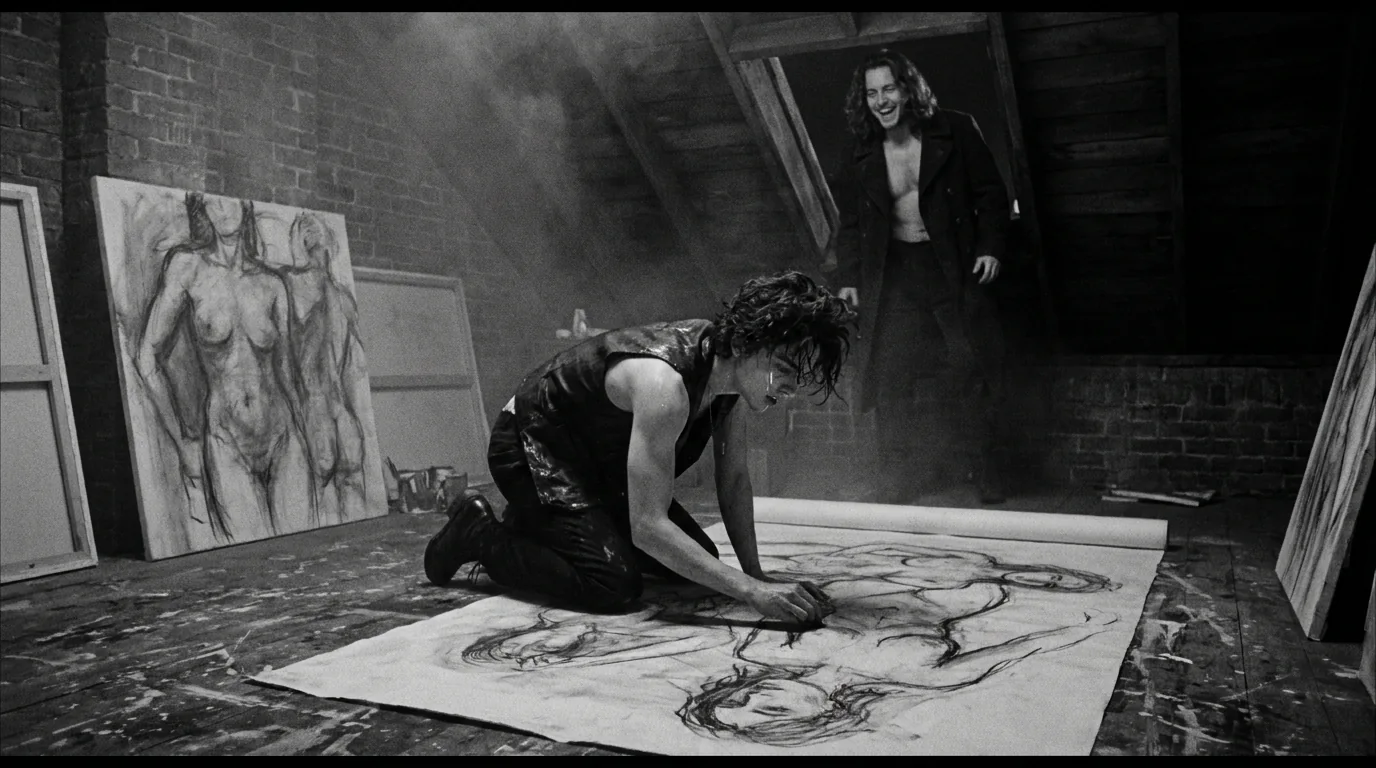
The revised screenplay offers an image sharper than a monologue: Clerval helps his sick friend back to a rooftop studio and finds canvases of nude men scattered across the room. It is not a reveal presented as a diagnosis. It is evidence of attention—of the subjects to which Victor returned while everyone else thought he was simply studying art.
There are risks in turning imagery into a definitive biography of a fictional person. Nude studies are an ordinary part of artistic training. Men can paint male bodies without being gay. The force of the sequence comes from juxtaposition: two years of secret work, the unexpectedly male person that work brings into the world, and Victor’s panicked refusal to remain in the same room with him.
Damian Wampler’s version imagines the horror of the closet as an aesthetic relationship. Victor thinks a drawn body belongs to him. When it begins to want something, he calls it a monster. The spectator must decide whether that word names the body or the feeling it provokes.
This is not a movie that needs to announce its thesis. The studio can do the talking.
Back to Mary Shelley’s 1818 text
“His limbs were in proportion, and I had selected his features as beautiful.”
What a modern adaptation can reveal
The most important objects in Victor's studio may be the drawings that reveal where he has been directing his attention. A drawn male body is both an aesthetic problem and a potential object of desire, and the film's horror begins when the distinction can no longer be maintained. An artist can touch a sketch, erase it, improve it or refuse to show it. A living person cannot be possessed under the same rules. The moment the drawn figure appears before Victor forces his habits of looking into the social world, where being seen might carry obligations and consequences.
Shelley gives Victor an aesthetic intention even before the Creature awakens. He chooses features he believes beautiful and then experiences revulsion when they enter living motion. That reversal is fertile territory for a queer interpretation, though no single reading has a monopoly on the scene. The shock might concern forbidden attraction, disgust at the embodied result, trauma at the power he has exercised, or the sudden loss of artistic control. Ambiguity is not indecision when the film builds its images precisely enough that viewers can understand more than one emotional account.
Mair Rigby's queer Gothic scholarship and Katie MacLean's comparison of Frankenstein with The Rocky Horror Picture Show show why desire has always mattered in the myth's reception. Such criticism concerns the ways a text invites readings of gender and sexuality, not a posthumous medical verdict on its fictional characters. The created male body destabilizes an order in which masculinity is supposed to remain unexamined, confident and productive. Victor's reaction can therefore be understood as panic at having made visible something he would rather keep within the studio.
A contemporary horror film has countless ways to film the male body as an object without imitating advertising or turning the Creature into a joke. Distance, stillness, fragments of a sketch, the direction of the gaze and the time a shot refuses to cut can create desire and discomfort simultaneously. The danger is treating beauty as a substitute for character. The Creature must become a person who can desire, think, rage, plead and make terrible decisions, rather than a passive image that exists only to expose Victor's repression.
The studio's final meaning may be an ethical one. Drawing begins as an intimate act of concentration; it becomes violent when the artist believes the imagined body belongs to him. The work of THE MONSTER is to make that movement visible and then ask whether an artist can learn to love what has escaped the frame.
Criticism and contemporary context
Mair Rigby’s account of Frankenstein’s queer Gothic is a starting point for interpreting desire without confusing an interpretation with a definitive statement about Shelley’s private intentions. Such research rewards close attention to what the characters cannot say.
Katie MacLean’s 2026 study comparing Frankenstein and The Rocky Horror Picture Show offers a contemporary scholarly account of masculinity and sexual convention. The two works are not tonally equivalent, but their comparison makes the adaptation tradition more revealing.
Editorial context. This is original analysis associated with the development of Damian Wampler’s screenplay THE MONSTER, inspired by Mary Shelley’s public-domain novel. Interpretive claims are presented as readings; named films and actors are not affiliated with the project.