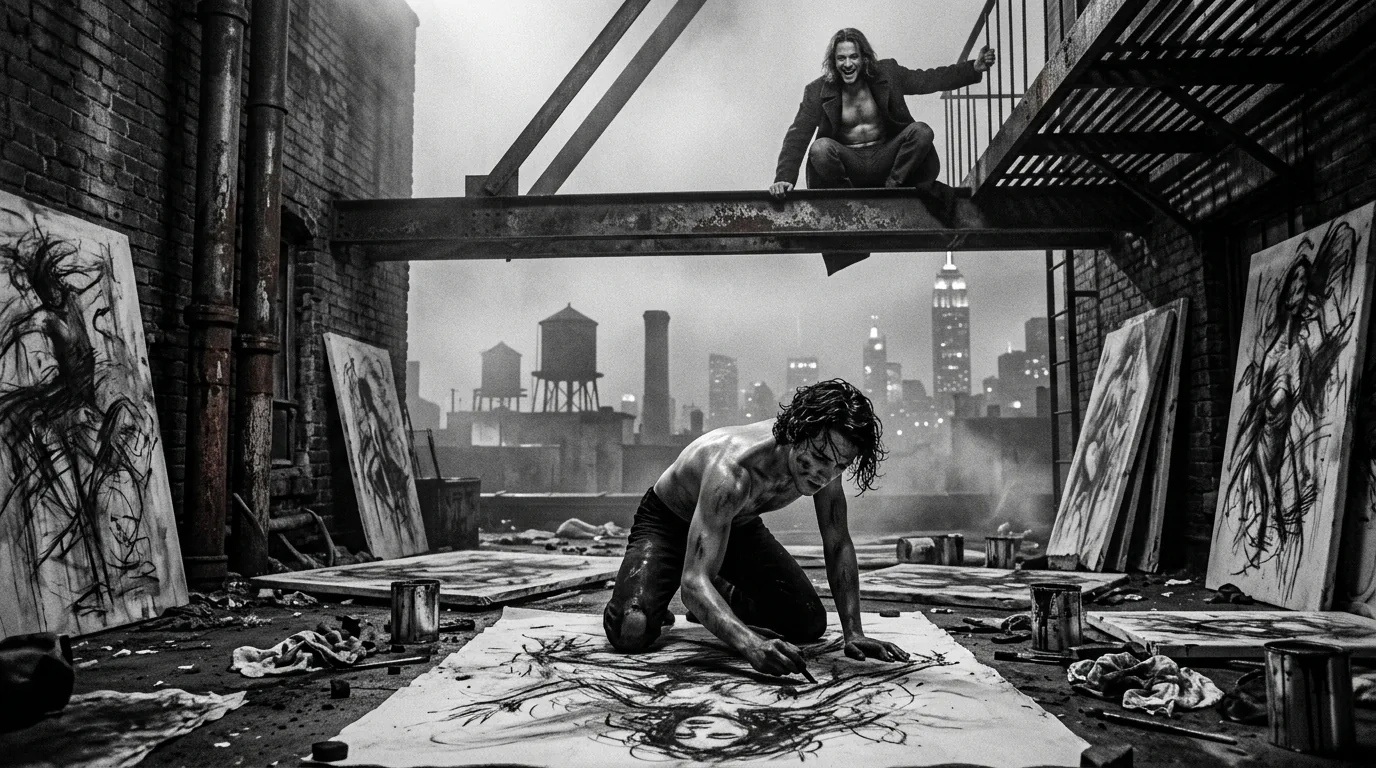
Victor wants a species to bless him as its origin. He undertakes creation privately, without a partner, and wants admiration for the result. Shelley’s story can be read as a radical fantasy of male reproduction: the desire to possess the prestige of giving life while circumventing maternal bodies and reciprocal relationships.
Damian Wampler’s adaptation preserves the uncomfortable inheritance. In the script, Victor is an artist, not a physician; the medium changes but the power fantasy does not. He can bring a man into being but cannot give that man a place in society. He can paint a companion for him, but refuses to allow her independence even before she exists.
Mary Shelley herself knew the costs of childbirth, maternal death, and infant loss. Biographical context matters, but it does not reduce the novel to a single autobiographical equation. Its larger moral confrontation is about the maker who demands authority while renouncing care.
The question 'should men create life?' becomes more interesting as 'what does creating life obligate a person to do?' THE MONSTER follows the parent who fails that obligation until the failure becomes an entire world of violence.
Back to Mary Shelley’s 1818 text
“A new species would bless me as its creator and source; many happy and excellent natures would owe their being to me.”
What a modern adaptation can reveal
The scientific miracle in Frankenstein is commonly framed as an advance in technology. Its more intimate audacity is that Victor attempts to make a child without a mother, a partner, or the ordinary social conditions of birth. He wants the power of generation while evading the reciprocal obligations usually attached to creating a dependent life. The language of discovery disguises the wish to become an origin point that owes nothing to anyone. When the Creature opens his eyes, the first event is not a technological failure but a failure of care.
Victor imagines a new species grateful to him, a fantasy of perfect paternal authority. Gratitude is built into the design before any created being has decided how to feel. This fantasy links the laboratory to domestic hierarchy: a father believes he may demand affection because he has provided life, shelter, or wealth. Yet parenthood cannot be measured exclusively by the creator's intention. The emotional measure arrives after the work is complete, when a vulnerable person needs recognition and the creator must decide whether to stay.
In the early nineteenth century, debates about generation, materialism, galvanism and the boundaries of life were active and contentious. Shelley's novel reflects that climate without being a prediction of any single later technology. The contemporary temptation is to present artificial intelligence or reproductive technology as proof that Frankenstein has come true. That comparison can be illuminating when it concerns accountability, but it becomes sloppy when it collapses fictional living beings, software, and actual children into the same category. The ethical questions may rhyme even where the technologies differ completely.
Damian Wampler's choice to make Victor a visual artist rather than a conventional scientist makes creation feel like an act of desire as well as ingenuity. A drawing is not naturally expected to demand legal standing, love, food, or companionship. The horror begins when an image refuses to remain an image and makes claims upon the person who imagined him. The camera can stay on Victor's face as he realizes that aesthetic perfection does not excuse him from responsibility. The work is finished; the relationship is only beginning.
The female Creature takes this argument in the opposite direction. Victor's power is terrifying not only because he can make life but because he can decide that a prospective life must be denied. The most uncomfortable question is not whether a man could technologically do this alone. It is what kind of person he becomes when he assumes that making something gives him the permanent right to rule it.
Criticism and contemporary context
In Emily Wotherspoon’s research on Elizabeth and Justine, the shrinking space granted to women across adaptations becomes a central artistic problem. That perspective is useful whenever a screen version gives its male creator complexity while leaving the women around him as consequences.
For the primary-text distinction, the Frankenstein Variorum project explains why the two major editions should be compared rather than quietly merged. Read the original source before treating a character’s changing biography as a fact that all adaptations necessarily share.
Editorial context. This is original analysis associated with the development of Damian Wampler’s screenplay THE MONSTER, inspired by Mary Shelley’s public-domain novel. Interpretive claims are presented as readings; named films and actors are not affiliated with the project.