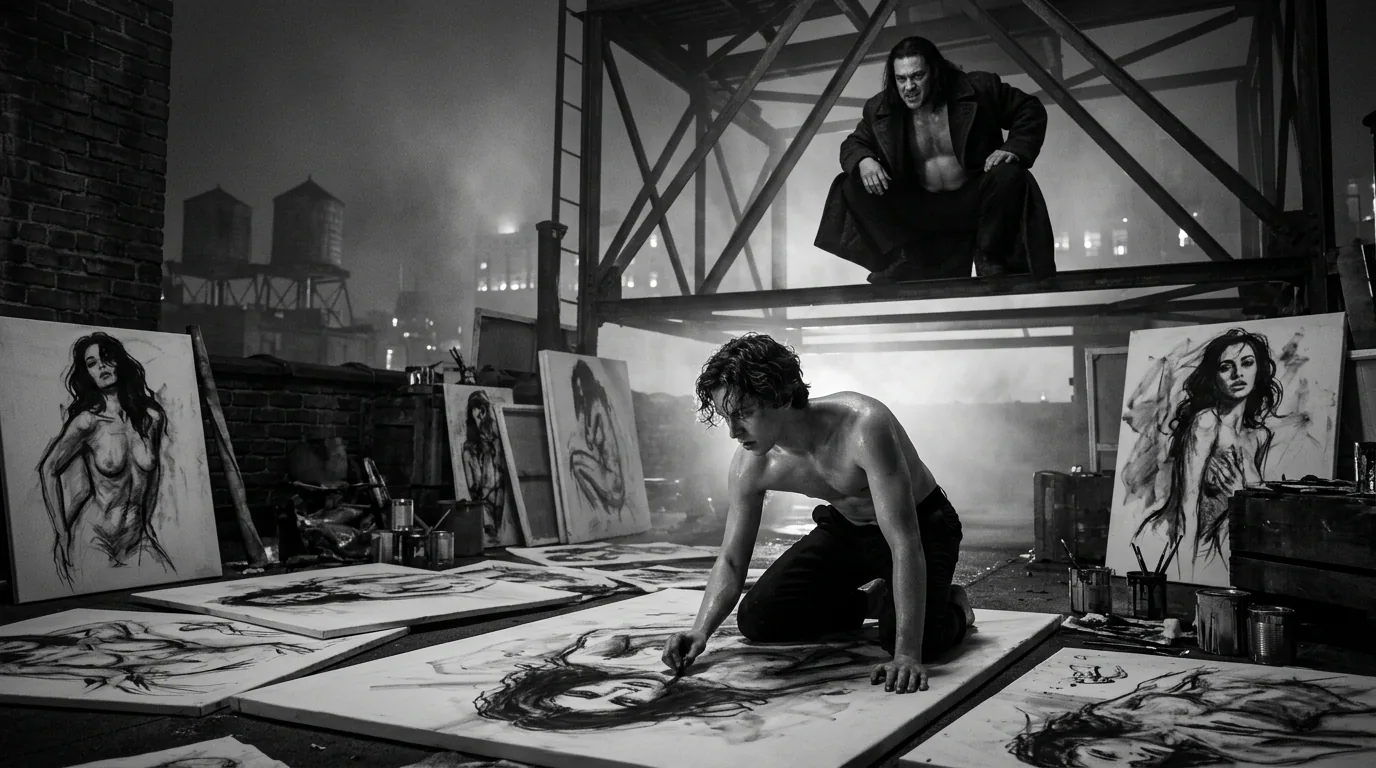
In Shelley’s novel, Victor begins building a female companion and then tears the unfinished body apart before animating it. His rationalizations multiply. She might refuse the Creature. She might be independent. Together they might have children. A woman not yet alive threatens him because he cannot guarantee she will behave as he expects.
This is more disturbing than an ordinary 'Bride of Frankenstein' set piece. The question is not only whether the Creature deserves a mate. It is why two men believe the future woman can be negotiated between them as property. When Victor destroys her, he is exercising power over an imagined person who has never been permitted to enter the conversation.
THE MONSTER restores the stopped creation as a visual and dramatic event. Victor paints a female figure and imagines the couple together. He nearly finishes. Then, before she can live, he destroys his work. The script makes the contrast between a painted promise and an erased possibility painfully direct.
Damian Wampler sees this as the scene that exposes the reproductive politics of the entire story. Without it, the novel’s dispute about women, parenthood, freedom, and control collapses into a more conventional revenge plot.
Back to Mary Shelley’s 1818 text
“I am alone, and miserable; man will not associate with me; but one as deformed and horrible as myself would not deny herself to me.”
What a modern adaptation can reveal
The female Creature has no voice, no consent and no opportunity to become wicked or good. That makes her one of the most politically charged absences in the novel. Victor begins making her because the Creature demands companionship; he destroys her because he imagines outcomes he cannot control. Her possible independence becomes the reason she may not live. The men are arguing about her future before she has an actual present. An adaptation that treats her only as another piece of horror makeup misses the radical discomfort of this predicament.
Shelley's scene does not tell the audience whether the woman would have loved the Creature, rejected him, harmed others or disappeared. The point is precisely that the characters cannot know. Victor's argument relies on conjecture: that she might possess preferences incompatible with the plan constructed for her. This is different from punishing someone for a demonstrated act. It is a decision to prevent a person from existing because the powerful fear what autonomy could make possible. The resulting ethical debate cannot be solved by declaring Victor either completely right or completely wrong.
The scene has deep relevance to feminist readings of the novel. Emily Wotherspoon's study of the erasure of female characters in later adaptations examines how women's subjectivities are narrowed by narratives organized around male desire. The unfinished female being is an extreme instance of that structure, not an automatic symbol for any one current political controversy. A careful essay or film can draw parallels to debates about reproductive power while acknowledging the distance between literary fantasy and actual people's bodies.
In THE MONSTER the unrealized creation is a painting, an image whose beauty makes its absence more poignant. The artist can obliterate the canvas without ever having to hear a refusal from the imagined subject. But the Creature, who asked for companionship, reads the destruction as another act of absolute contempt. Both male characters respond by imposing their will on others. The scene's emotional terror lies in the fact that we cannot ask the one person at its center what she wants.
A powerful screen version would permit silence after the destruction. There is no Bride performance to resolve the image; there is only the knowledge that a future has been deliberately interrupted. The audience might debate Victor's fear and the Creature's coercion. It should also remember the absent woman who remains the most consequential character never to appear.
Criticism and contemporary context
In Emily Wotherspoon’s research on Elizabeth and Justine, the shrinking space granted to women across adaptations becomes a central artistic problem. That perspective is useful whenever a screen version gives its male creator complexity while leaving the women around him as consequences.
For the primary-text distinction, the Frankenstein Variorum project explains why the two major editions should be compared rather than quietly merged. Read the original source before treating a character’s changing biography as a fact that all adaptations necessarily share.
“This results in a silence in the culture-text about the presence of women in this story.”
Editorial context. This is original analysis associated with the development of Damian Wampler’s screenplay THE MONSTER, inspired by Mary Shelley’s public-domain novel. Interpretive claims are presented as readings; named films and actors are not affiliated with the project.