Some readers see Victor’s relationship to the Creature as the externalization of forbidden desire. Others see narcissism, failed fatherhood, or a frightened creator confronting what cannot be controlled. Mair Rigby and Michael Eberle-Sinatra have examined how queer meanings emerge in both novel and cinema. Ruth Franklin has made this conversation accessible to broader readers.
Damian Wampler’s THE MONSTER steps deliberately into that discussion. Its young male creator spends years constructing an alluring male figure. A tactile encounter makes him recoil. The horror returns in scenes of displaced eroticism and finally at the site of an expected heterosexual wedding.
But a strong film should be playable for an audience that rejects that reading too. Victor could fear responsibility, adulthood, social humiliation, intimacy, or every one of those at once. The Creature’s needs do not diminish because Victor’s motivations are difficult to name.
Literature survives because it contains more than one theory. The point is not to solve Mary Shelley with a modern label. The point is to permit the questions that so many conventional screen versions have treated as a distraction.
Back to Mary Shelley’s 1818 text
“His limbs were in proportion, and I had selected his features as beautiful.”
What a modern adaptation can reveal
Queer readings of Frankenstein do not require the claim that Mary Shelley secretly intended to write a novel about a modern sexual identity. They begin with the text's invitations: intensity between men, secrecy, aversion to heterosexual obligations, the Creature's status as an intimate double and the extraordinary prominence of male bodies and reproductive control. Mair Rigby's queer Gothic scholarship traces how sexual nonconformity has been made legible through Gothic forms. Michael Eberle-Sinatra examines how such readings intersect with screen adaptations. These are interpretive approaches, not a unanimous scholarly verdict.
The Creature is especially interesting because he can function as the externalized result of Victor's private desires while remaining a fully independent person. If an audience sees him as a figure of forbidden longing, his abandonment becomes an act of self-rejection that injures someone other than the rejecting self. If viewers instead see him as a son, a technological accident or an exploited worker, the same act has another moral contour. A sophisticated film can hold those readings simultaneously if it resists explaining every emotion.
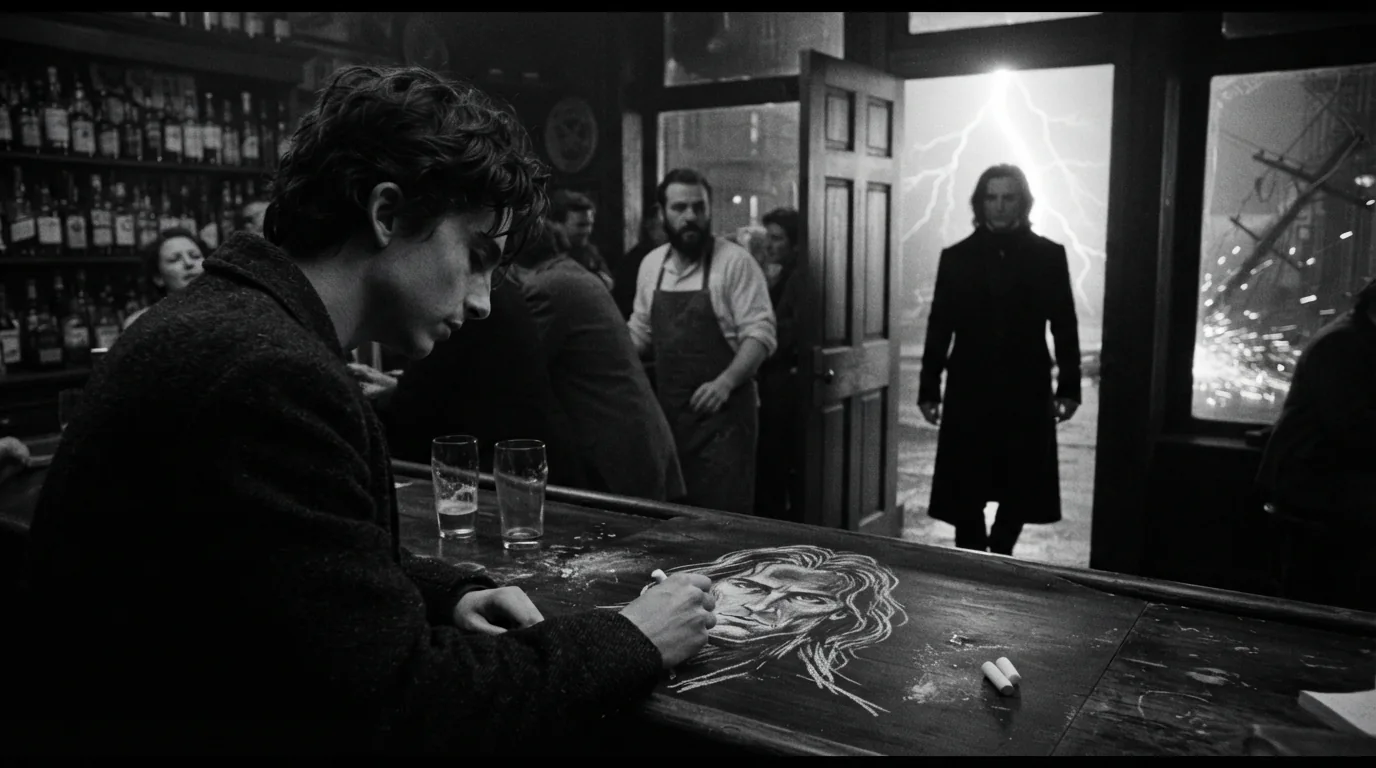
Wampler's screenplay makes the possibility more visually immediate. An eighteen-year-old male artist devotes two years to a compelling male figure; the figure comes alive and approaches him; Victor recoils. The event may read as panic at attraction, loss of artistic control, terror of adulthood or shock at a metaphysical miracle. A slow close-up or an interrupted gesture can let those interpretations coexist. The film does not need a speech telling viewers what Victor “really” is, because the tension lies in his refusal to know himself.
Katie MacLean's 2026 scholarship on Frankenstein and The Rocky Horror Picture Show places the myth's masculinity and sexual norms in a productive comparative frame. Rocky Horror is overtly theatrical, playful and sexual; Wampler's proposal is subdued and Gothic. They occupy different registers, but both reveal how the story can unsettle the expectation that masculinity must be stable, transparent and conventionally reproductive. A critical reading of these works should distinguish a film's explicit content from the subtext a viewer brings to the novel.
The crucial ethical safeguard is that queerness itself must not become the monster. The real harm in the new screenplay arises from shame, abandonment, coercion and the refusal to accept another person's autonomy. The film should be legible as a story about the damage done by repression, not an allegation that same-sex longing makes someone violent. That difference matters artistically as much as politically.
Criticism and contemporary context
Mair Rigby’s account of Frankenstein’s queer Gothic is a starting point for interpreting desire without confusing an interpretation with a definitive statement about Shelley’s private intentions. Such research rewards close attention to what the characters cannot say.
Katie MacLean’s 2026 study comparing Frankenstein and The Rocky Horror Picture Show offers a contemporary scholarly account of masculinity and sexual convention. The two works are not tonally equivalent, but their comparison makes the adaptation tradition more revealing.
“Frankenstein is a productive text for discussing modern western culture’s tendency to produce the possibility of sexual nonconformity as a Gothic horror story.”
Editorial context. This is original analysis associated with the development of Damian Wampler’s screenplay THE MONSTER, inspired by Mary Shelley’s public-domain novel. Interpretive claims are presented as readings; named films and actors are not affiliated with the project.