Guillermo del Toro’s Frankenstein (2025) is a lavish, intensely personal film. It is invested in fatherhood, forgiveness, and the Creature’s hunger to be seen. Its visual accomplishment is real; so is its distance from the particular novel Damian Wampler wants to engage.
Del Toro makes Elizabeth the fiancée of Victor’s brother William rather than Victor’s intended bride. Henry Clerval is omitted. Victor never undertakes the long, nearly completed creation of a female companion before destroying her. Those changes do more than shorten an episodic book: they alter the relationships that make the wedding-night threat, the best-friend intimacy, and the unmade woman so troubling.
The result is an eloquent film about a cruel father and an abandoned son. It is less willing to sit inside the novel’s interlocking fears of marriage, forbidden desire, class, and reproductive control. That is an editorial judgment, not a claim that del Toro misunderstood every aspect of Shelley or that his film has no queer interpretation.
THE MONSTER seeks a different center of gravity: the eighteen-year-old maker, the lover raised within his family, the friend he cannot save, and the man whose creation embarrasses him before it terrifies him.
Back to Mary Shelley’s 1818 text
“His limbs were in proportion, and I had selected his features as beautiful.”
What a modern adaptation can reveal
Guillermo del Toro's 2025 Frankenstein is a splendid example of why the old myth remains artistically open. It is a consciously authored interpretation, not an illustrated edition of Mary Shelley. Its gothic surfaces, emotional emphasis and father-son framework make the Creature's suffering comprehensible through recognizable familial cruelty. The decision to make the film about inherited pain is powerful. It also makes it possible to see what another filmmaker might emphasize instead: a very young creator whose artistic desire, shame, class privilege and intimacy with his beautiful male creation drive the story from within.
The source relationships should not be silently imported into a comparison. Del Toro positions Elizabeth as the fiancée of Victor's younger brother William; Shelley makes her Victor's intended bride, though her origins differ between the novel's editions. Changing kinship changes the meaning of the wedding-night catastrophe, the distribution of sexual jealousy and the obligations of family members. The difference is not a small plot technicality. It reorganizes the emotional geometry of the entire story, particularly when the adaptation's central claim concerns fathers and sons.
Christopher Frayling's 2026 Criterion essay and British Association for Romantic Studies discussion offer informed starting points for understanding those choices. The most productive criticism is not that del Toro “got it wrong”; a major artist is entitled to translate the material into a personal language. The useful question is what becomes visible in that translation and what disappears. A filmmaker's fidelity to an emotional theory may require unfaithfulness to the events that originally made another emotional theory possible.
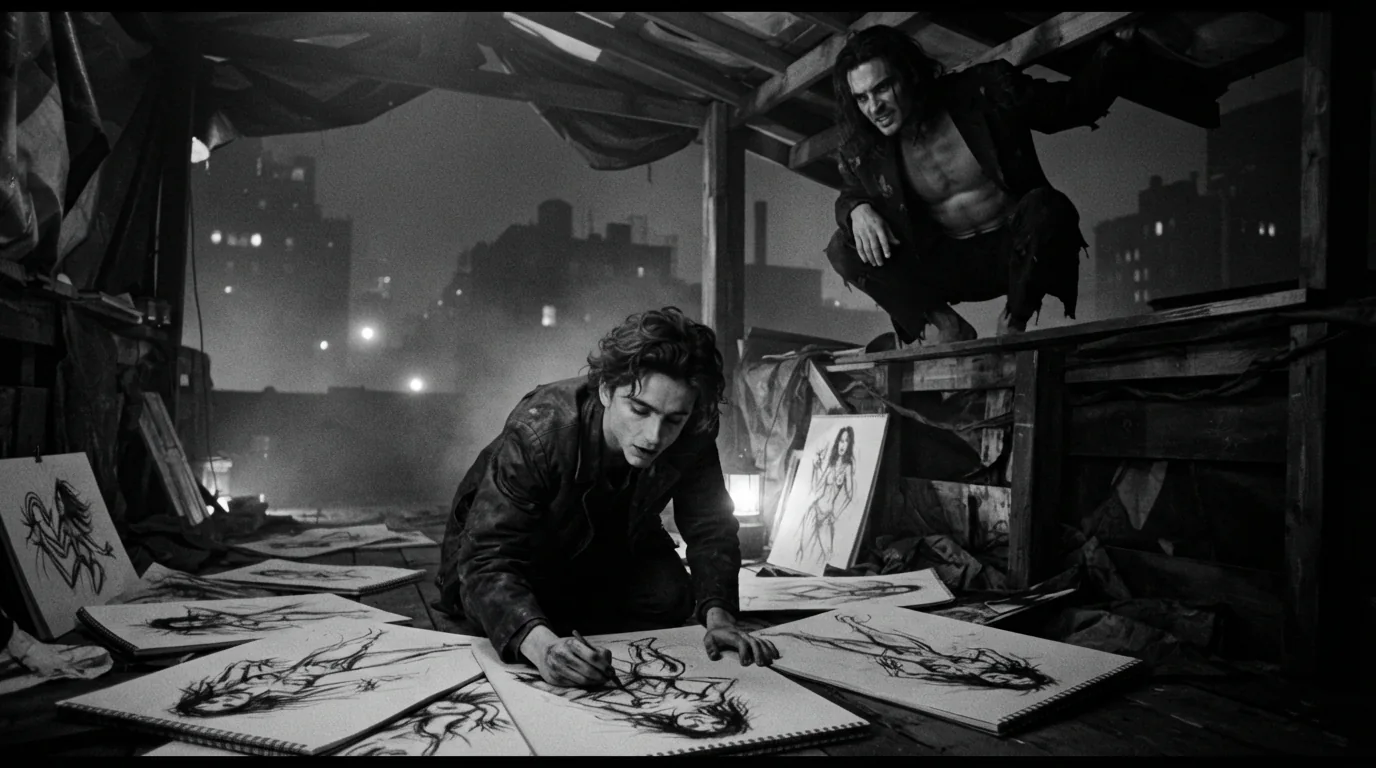
The 2025 film also gives contemporary audiences a renewed vocabulary for talking about beauty. A Creature who is commanding, wounded, and physically compelling complicates the habitual expectation of immediate ugliness. Shelley herself gives Victor a design initially imagined as beautiful, then describes the shock of its animation. Wampler's project takes the artist's aesthetic intention and holds it under the camera for much longer: the drawn young man matters as the object of sustained attention, not simply as a costly effect after the laboratory work is done.
The existence of a major recent adaptation is not an argument against another film. It is the strongest possible demonstration that Frankenstein is an interpretive field rather than a fixed screenplay. Del Toro foregrounds one kind of generational wound. A different feature can ask what happens when desire creates a person whom the desirer cannot bear to acknowledge. Those films need not compete for the status of definitive adaptation; they can make each other's omissions legible.
Criticism and contemporary context
Christopher Frayling’s October 2026 Criterion essay places del Toro’s film in a longer historical and artistic conversation. It is a strong companion to this essay precisely because admiration for one director’s accomplishment need not erase the arguments another adaptation could make.
The BFI’s 2026 notes on del Toro’s film emphasize its chosen emphasis on family and inherited pain. That is one revealing way into the myth, among several that serious critics and filmmakers can explore.
“a family movie – a father and son ‘generational pain’ story.”
Editorial context. This is original analysis associated with the development of Damian Wampler’s screenplay THE MONSTER, inspired by Mary Shelley’s public-domain novel. Interpretive claims are presented as readings; named films and actors are not affiliated with the project.