Shelley’s portrait of Alphonse as Caroline’s rescuer is suffused with admiration. He arrives after Beaufort’s fall, tends to Caroline, and eventually marries her. Yet an economic reading cannot ignore the asymmetry: one person holds resources, the other has none, and the marriage follows the rescue.
We need not read this relationship as proof of a villainous Alphonse. The more troubling idea is that sincere kindness can still belong to an unequal system. Power need not be consciously cruel to organize everyone else’s life.
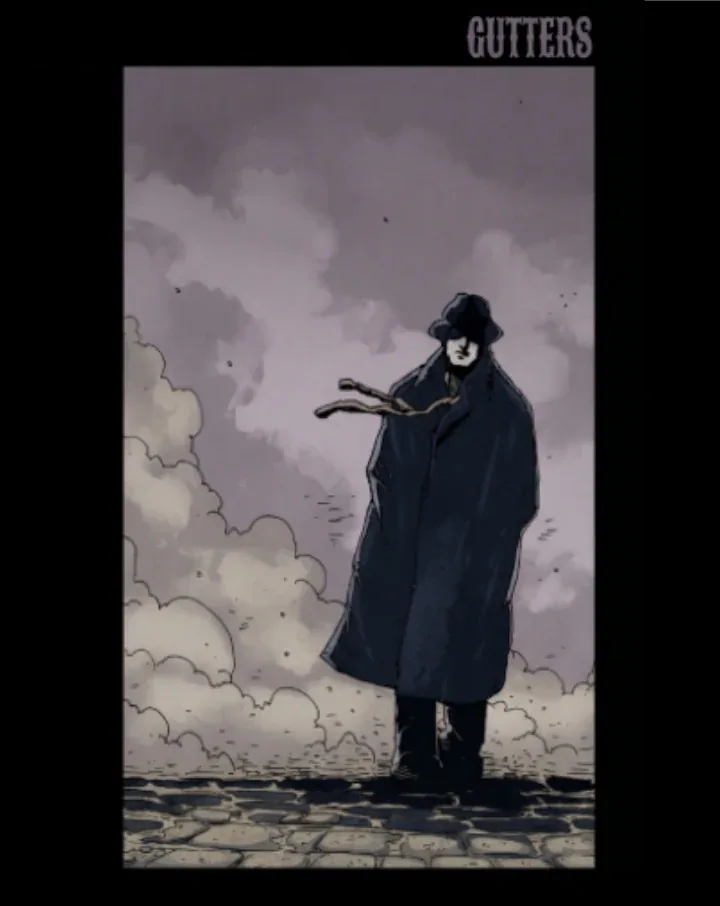
That is the dramatic territory of GUTTERS, Damian Wampler’s unpublished comic. Where blockbuster adaptations begin with thunder and machinery, the comic begins with what the family prefers to call good fortune. One man chooses who may enter the house; later his son chooses who may enter the world.
It is difficult to find a more efficient prequel to Frankenstein than this: follow the money, then follow the idea of ownership into the next generation.
Back to Mary Shelley’s 1818 text
“I heard of the division of property, of immense wealth and squalid poverty; of rank, descent, and noble blood.”
What a modern adaptation can reveal
The history of Alphonse and Caroline seems sentimental when reduced to a rescue story. A well-connected man finds a once-respectable woman living in poverty, protects her, and marries her. Shelley's narration renders that marriage as an act of gratitude and devotion. Read with attention to material circumstances, however, it becomes a narrative about who has the resources to convert another person's crisis into a family origin myth. Caroline's father Beaufort loses his fortune; she supports him with difficult work; Alphonse arrives as a rescuer from another social world. What follows is love embedded inside economic dependence.
It matters that Caroline is not born into permanent poverty. Her descent from respectable comfort makes her eligible for a novelistic rescue that eighteenth- and nineteenth-century fiction often withholds from women without pedigree. The family's subsequent opulence does not erase the memory of want; it converts it into the kind of story affluent families can retell safely at dinner. The poor girl becomes the mother in the portrait. Her vulnerability survives in the household's assumptions about whom one must protect, possess, and marry.
In THE MONSTER, Alphonse and the absent mother do more than explain Victor's childhood. They establish a grammar of control. Affection sounds like instruction; a dying wish can determine another person's romantic future; a wealthy father's grief can coexist with expectations that his son will perform a proper marriage. Those dynamics are more interesting if Alphonse is neither a cartoon villain nor an innocent benefactor. His money can genuinely protect people, and it can teach him not to see what that protection costs them.
Anca Vlasopolos's reading of oppression in Frankenstein is useful here because it takes the household's apparent benevolence seriously enough to examine the forms of authority hidden within it. Not every kind act is a manipulation, but affection cannot be analyzed apart from the options available to the recipient. Caroline's marriage is an ideal case: we can believe in her love for Alphonse and still ask whether the story knows how to describe her independence. A modern film can stage that uncertainty with a portrait, a silence, or the way the living speak about a woman who can no longer contradict them.
The point is not to prosecute an eighteenth-century marriage by twenty-first-century rules. It is to show how Mary Shelley makes class legible inside intimate relationships. Behind the comfortable mansion stands a collapse of fortune, a rescued daughter, and a new family that has learned to mistake protection for ownership. Victor inherits more than wealth: he inherits the idea that love confers authority over the people one claims to save.
Criticism and contemporary context
Anca Vlasopolos’s study of oppression in Frankenstein provides a critical counterweight to readings concerned only with individual ambition. It helps explain why domestic affection, social position and the right to be believed matter within the horror story.
The side-by-side discussion of the 1818 and 1831 texts makes the underlying textual choices inspectable. A screen adaptation may select or alter those details, but criticism becomes more persuasive when it names the source version it is using.
Editorial context. This is original analysis associated with the development of Damian Wampler’s screenplay THE MONSTER, inspired by Mary Shelley’s public-domain novel. Interpretive claims are presented as readings; named films and actors are not affiliated with the project.