The 1910 Edison film is important not because it invents every later laboratory cliché but because it demonstrates the urge to simplify the psychological problem. This early screen adaptation condenses the story and resolves the Creature through a mirror-image device. The murders of William and Elizabeth that structure Shelley’s tragedy are not carried through in the same form.
Its creators were adapting a novel to the visual grammar and exhibition limits of a short silent film. That is an achievement of early cinema. It is also the beginning of a pattern: the screen version locates the horror in a visible creature and a moment of transgression, rather than the prolonged social and sexual wreckage of Victor’s family.
Damian Wampler’s THE MONSTER is an explicit rebuttal to this habit, though it changes the novel in its own way. It wants the emotional crimes, the friend, the wrongfully accused girl, the woman who will never be brought to life, and the wedding night back in the foreground.
The first film discovered how easily the story could be converted into a fable about moral purification. The new film asks what happens if no mirror can make Victor innocent.
Back to Mary Shelley’s 1818 text
“His limbs were in proportion, and I had selected his features as beautiful.”
What a modern adaptation can reveal
The Edison Company's 1910 Frankenstein is remarkable less for anticipating every later visual convention than for demonstrating how quickly an adaptation can alter a story's moral logic. In a short silent film, the problem of the Creature becomes an image to be overcome through a transformation of Victor's inner state. The form is ingenious, but the movement toward resolution differs sharply from the novel, where abandonment generates deaths, persecution, and finally a pursuit toward the polar ice. The question is not whether a short early film should have reproduced a complex book. It is what happens when the Creature's claim upon his maker is condensed into a problem of conscience.
One can admire silent-film invention while recognizing the economic and formal pressures of adaptation. Brief running times, limited effects, moral framing and the need for striking images encourage simplification. The Monster becomes a spectacle whose meaning can be delivered in a single visual trick. But Shelley refuses to make the consequences vanish with a sudden change of heart. She lets the Creature speak, accumulate experience and insist that the creator's guilt is not the same as repair.
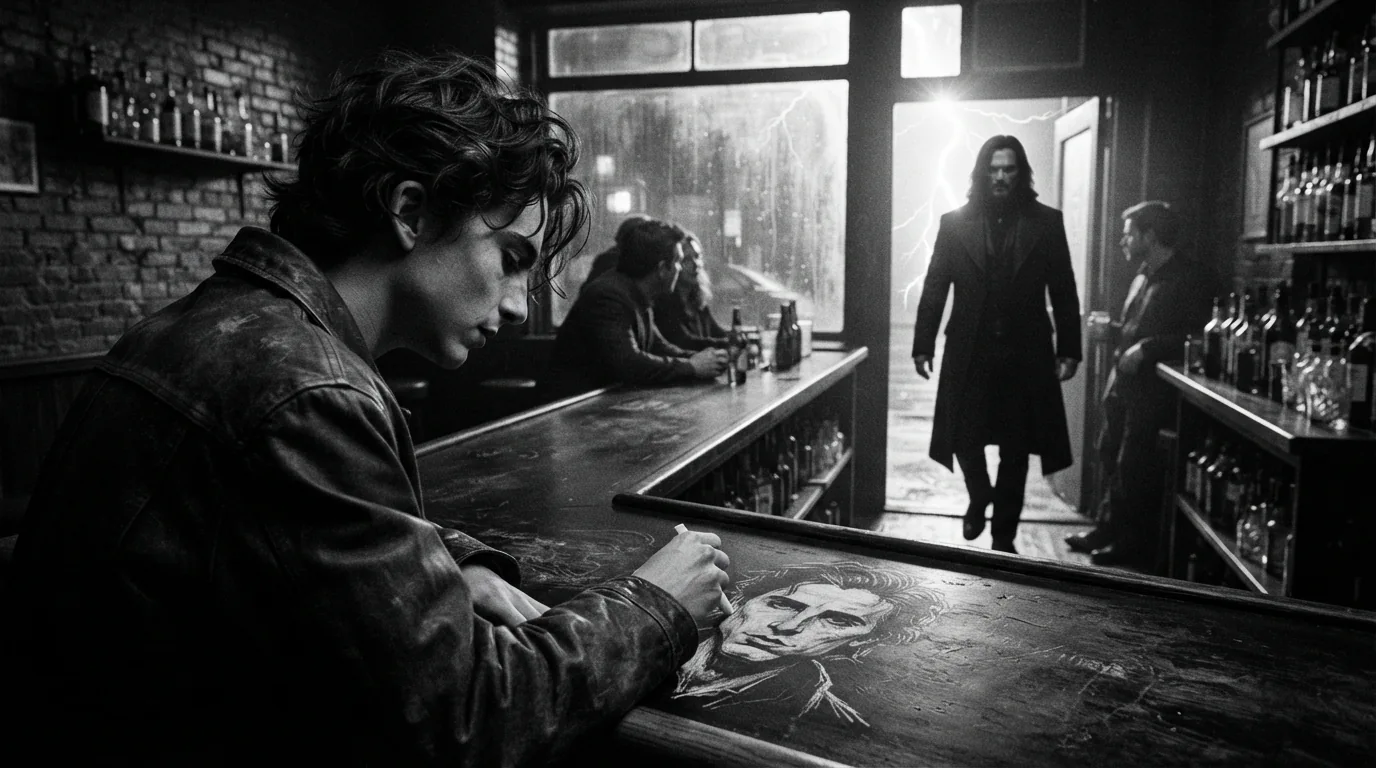
The 1910 film also belongs to an era before Whale's industrial laboratory became the dominant cinematic image of creation. It is an opportunity to recover alternative visual possibilities. The flickering, superimposed, unstable body can suggest creation as an optical disturbance rather than as mechanical engineering. In Wampler's modern film the image-to-body transformation belongs to the grammar of photography, drawing and spectatorship. A person steps out of an artwork, and the artist discovers that looking is no longer a one-way transaction.
Film history should be used as a record of creative choices rather than a scoreboard of which directors understood Shelley best. The older short had reasons to pursue clarity and visual economy. A modern feature has the luxury of making incompleteness and ambiguity part of its power. The audience need not receive a simple moral cure; it can remain troubled by the fact that Victor may suffer without learning how to care.
The 1910 film therefore provides a productive counterexample. It shows the attraction of making the monster an image that can be dispelled. THE MONSTER is built on the opposite wager: once the artist has made a person, neither artistic control nor regret can return that person to a harmless picture.
Criticism and contemporary context
A 2026 article in Adaptation compares screen versions through the Creature’s ethical status. That approach keeps the discussion away from trivia about matching details and closer to the matter of whose experience cinema asks its viewers to understand.
The Library of Congress National Film Registry provides useful background for the classic screen-image tradition. Consider how that film history shapes what audiences think Shelley wrote, then return to the novel for the differences.
Editorial context. This is original analysis associated with the development of Damian Wampler’s screenplay THE MONSTER, inspired by Mary Shelley’s public-domain novel. Interpretive claims are presented as readings; named films and actors are not affiliated with the project.