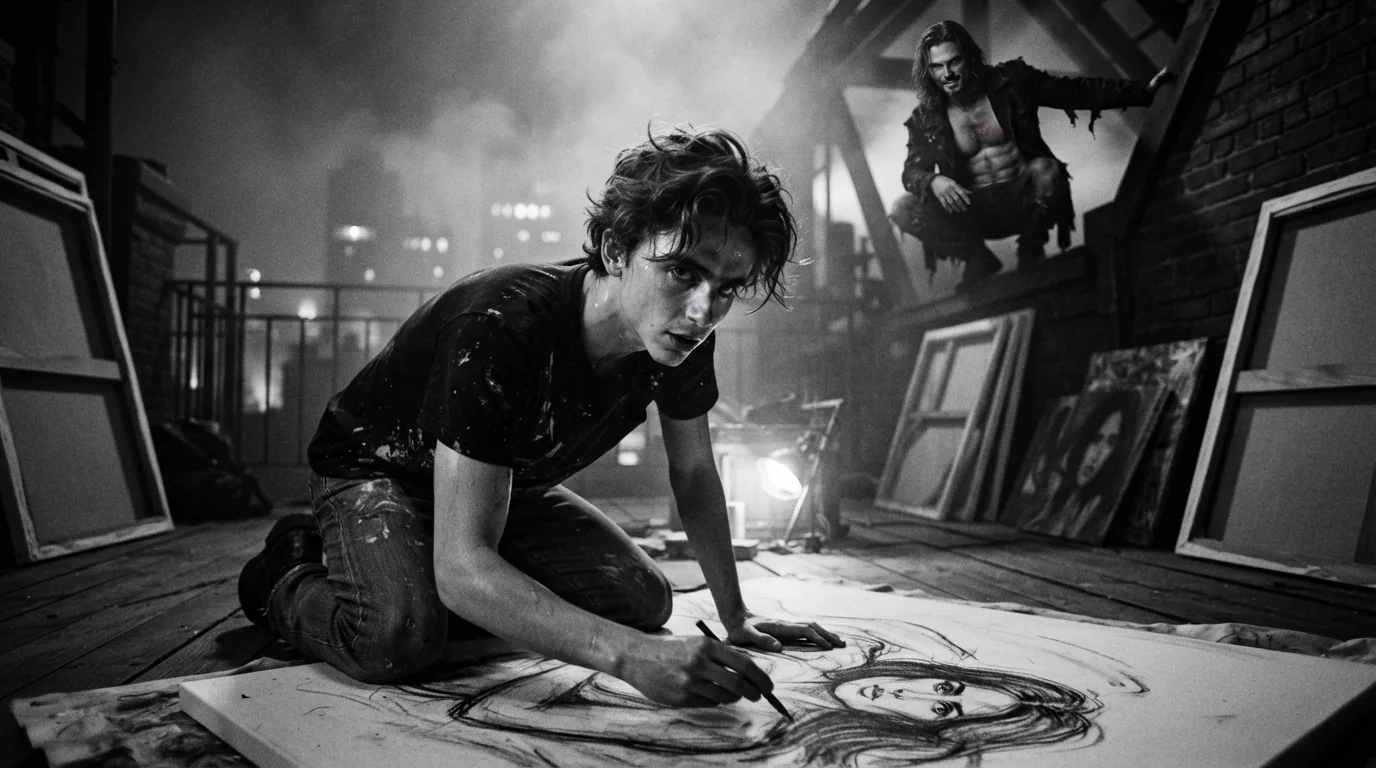
In the current screenplay, the incomplete companion is not a reassembled corpse. She is an image Victor paints into existence. The canvas begins to show a woman’s face, bold cheekbones, full lips, and strange yellow eyes. Other images imagine her alongside the Creature in a wilderness where the pair could live without being hunted.
Damian Wampler has described a Salma Hayek–evoking painted face as a visual reference for this sequence. That is a concept direction, not an indication of any conversation, endorsement, image license, or attachment involving Salma Hayek. The intended effect is sensual, iconic, and immediate: a full person is imaginable before Victor decides she is too dangerous to exist.
This makes the destruction of the work fundamentally different from killing a monster in combat. The woman can do nothing to stop the hand that erases her. The camera can linger on the line between aesthetic judgment and the moral failure of deciding someone should not be born.
A film this visually literate does not need to explain every motif. The disappearing face can bear the whole argument.
Back to Mary Shelley’s 1818 text
“I am alone, and miserable; man will not associate with me; but one as deformed and horrible as myself would not deny herself to me.”
What a modern adaptation can reveal
An image of a bride can look like a promise fulfilled before the bride has ever spoken. In Frankenstein the proposed companion is designed by men who believe they understand what she would mean to another man. Victor's work is interrupted by an imaginative crisis: what if she did not consent to the role for which she had been created? What if she wanted something else? The underlying horror is less the possibility of female monstrosity than the male certainty that her life can be decided in advance.
A painting translates that conflict into a cinematic object. A canvas can be looked at, touched, revised, hidden or destroyed. A human being, once alive, can reject the painter and the commission alike. In Wampler's modern version, the moment Victor chooses not to animate the portrait is therefore the end of one imagined contract. The Creature wants a companion; Victor wants control over what that companionship could become. Neither can honestly guarantee how the woman herself would feel.
The familiar Bride of Frankenstein iconography can be useful as an explicit contrast. The 1935 film creates a woman who briefly lives and refuses her proposed partner. Shelley never grants the unfinished woman even that moment. The two versions should not be collapsed: one stages rejection after life begins, while the other stages the prevention of life because a man fears rejection and independence. This is why a brief, quiet image can carry a weight that special-effects spectacle might flatten.
Research on the erasure of women in the Frankenstein adaptation tradition places this absence within a wider pattern. Emily Wotherspoon argues that the culture-text often redirects Elizabeth and Justine toward male romantic narratives, limiting their own relationships and subjectivity. The prospective female Creature represents an even more extreme structural silencing. She is the woman who cannot become a character because the men discussing her cannot surrender control of the script.
The painting should frighten the audience before it frightens Victor. It holds the possibility of a person whose subjectivity may never be known. Destroying it might prevent future harm, as Victor believes, but it also becomes an exercise of absolute authority over a being who has done nothing. A film willing to leave both implications unresolved can recover one of Shelley's most extraordinary dilemmas.
Criticism and contemporary context
In Emily Wotherspoon’s research on Elizabeth and Justine, the shrinking space granted to women across adaptations becomes a central artistic problem. That perspective is useful whenever a screen version gives its male creator complexity while leaving the women around him as consequences.
Jodie Marley’s January 2026 discussion for the British Association for Romantic Studies is useful for distinguishing inherited Gothic material from a recent adaptation’s new dramatic relationships. The changes are worth understanding, not simply scoring as mistakes.
Editorial context. This is original analysis associated with the development of Damian Wampler’s screenplay THE MONSTER, inspired by Mary Shelley’s public-domain novel. Interpretive claims are presented as readings; named films and actors are not affiliated with the project.