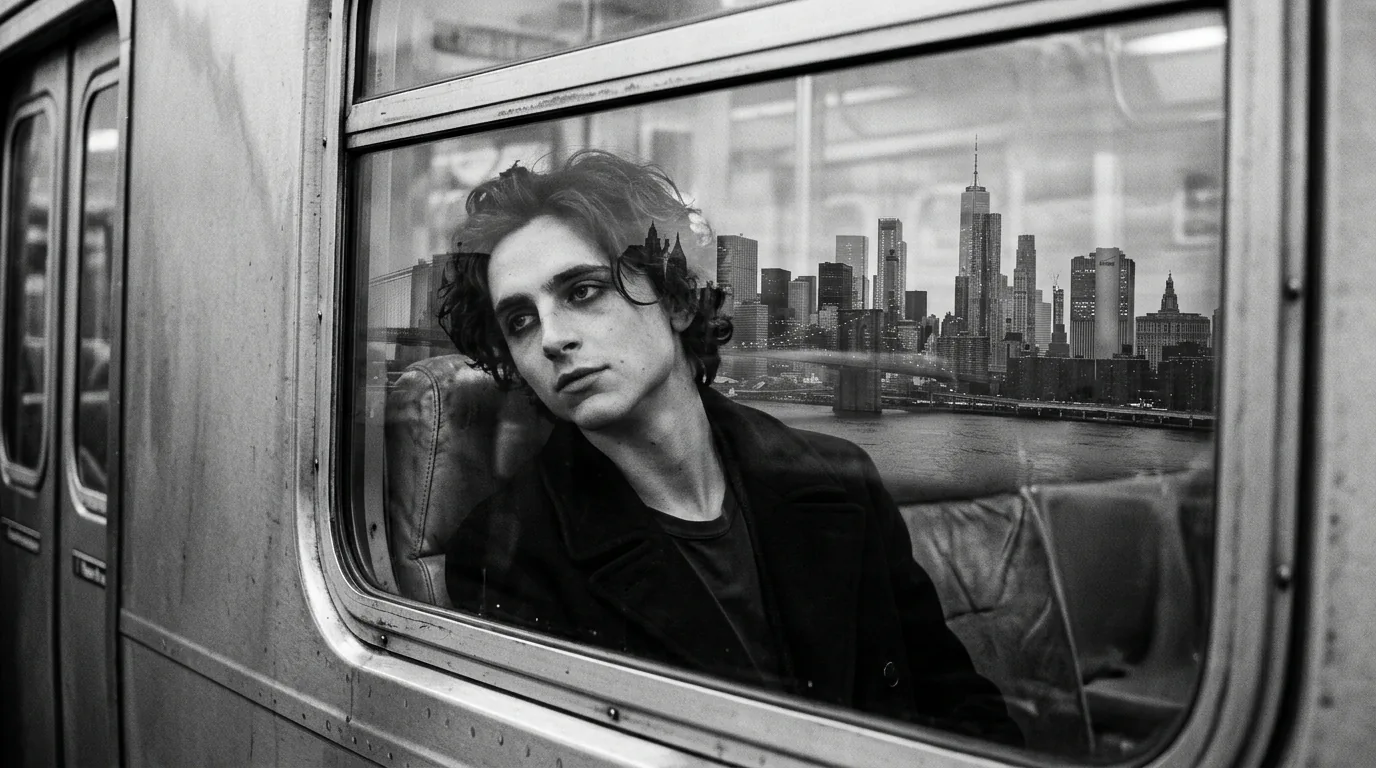
Not every screen Frankenstein is a green giant. Films and television have periodically experimented with a handsome or initially attractive Creature. Frankenstein: The True Story (1973) uses the disturbing idea that beauty might degrade. Shelley’s own description mixes features selected for beauty with features Victor experiences as abhorrent once animated.
THE MONSTER takes the experiment a different direction. A visually captivating young man steps out of a sketch. Victor's horror is not adequately explained by disfigurement. That makes the encounter harder to classify, especially when the stranger’s hand and gaze feel uncomfortably intimate.
Damian Wampler has identified Damian Hurley as his top dream-cast target for the Creature, with a starring role that could be a breakout for an actor-model-director. This is a wish, not an attachment or confirmed discussion. The actor’s appearance is part of the proposed vision, not evidence of his participation.
A beautiful Creature is not a softening of horror. It denies Victor the excuse that he was merely reacting to ugliness. If the man is beautiful, what exactly is so intolerable about being seen by him?
Back to Mary Shelley’s 1818 text
“His limbs were in proportion, and I had selected his features as beautiful.”
What a modern adaptation can reveal
The assumption that Frankenstein's Creature must be immediately hideous is often treated as a requirement of the original novel. The actual creation scene is stranger. Victor deliberately selects features he considers beautiful, then is horrified when the body awakens. Shelley's account describes an unsettling combination of black hair, white teeth, yellow skin and watery eyes. The paradox between intended beauty and experienced revulsion is not an incidental detail. It suggests that the failure lies partly in the creator's ability to accept an embodied result that no longer obeys the logic of his fantasy.
A film can pursue that paradox without insisting that every audience member find the created man conventionally attractive. Beauty is relational and unstable. A carefully framed face may seem alluring in one light and uncanny in another. More importantly, the sight of a beautiful being does not guarantee that Victor will welcome him. If the Creature is the product of a two-year aesthetic obsession, Victor's rejection becomes an especially revealing act: the body matches his concentration but refuses to remain a controllable image.
Recent adaptations have shown that an emotionally compelling Creature can change the entire dynamic of the myth. Del Toro's 2025 film is one contemporary point of comparison, while the older cinema tradition is full of designs that emphasize injury and visual difference. Wampler's proposal leans into youth and desirability as an interpretive choice. It invites questions about shame, erotic looking and the fear that one's deepest private interest could become visible to others.
Mair Rigby's queer Gothic approach helps explain why this shift may carry implications beyond appearance. The male body becomes the site where forbidden or unclassified feeling is exposed. Yet the film should never require an audience to accept one fixed account of Victor's sexuality. The same scene can express narcissism, terror of responsibility and a profound inability to acknowledge another consciousness. Its strength comes from the precision of the encounter, not a label pasted over it.
The hardest task for the actor playing the Creature is to make beauty a beginning rather than an identity. The person who steps out of the drawing must learn, want, misunderstand and eventually fight. A handsome design becomes dramatically radical only if the narrative grants the beautiful object the full, unruly autonomy of a person.
Criticism and contemporary context
Christopher Frayling’s October 2026 Criterion essay places del Toro’s film in a longer historical and artistic conversation. It is a strong companion to this essay precisely because admiration for one director’s accomplishment need not erase the arguments another adaptation could make.
Mair Rigby’s account of Frankenstein’s queer Gothic is a starting point for interpreting desire without confusing an interpretation with a definitive statement about Shelley’s private intentions. Such research rewards close attention to what the characters cannot say.
Editorial context. This is original analysis associated with the development of Damian Wampler’s screenplay THE MONSTER, inspired by Mary Shelley’s public-domain novel. Interpretive claims are presented as readings; named films and actors are not affiliated with the project.