Kenneth Branagh’s film has real ambitions toward the book. It restores the Arctic frame, gives the Creature language and grief, and stages Victor’s hubris as a feverish bodily drama. It should not be dismissed as an adaptation that ignores Shelley entirely. Its most revealing departure comes at the point Damian Wampler cares about most.
The novel’s Victor constructs a female and destroys her before animation. Branagh instead resurrects the murdered Elizabeth using a female body assembled from Elizabeth and Justine, then places the reborn woman between Victor and the Creature. It is a striking horror image, but it is not Shelley’s scene. The refusal of a woman who has never lived is converted into a jealous battle over a woman already loved.
The new spectacle creates melodrama where the novel posed a harder ethical question. Why may Victor grant life to one man and withhold it from a woman because he fears her choices? The scene is important precisely because no actress needs to perform her response. Her possibility is the battleground.
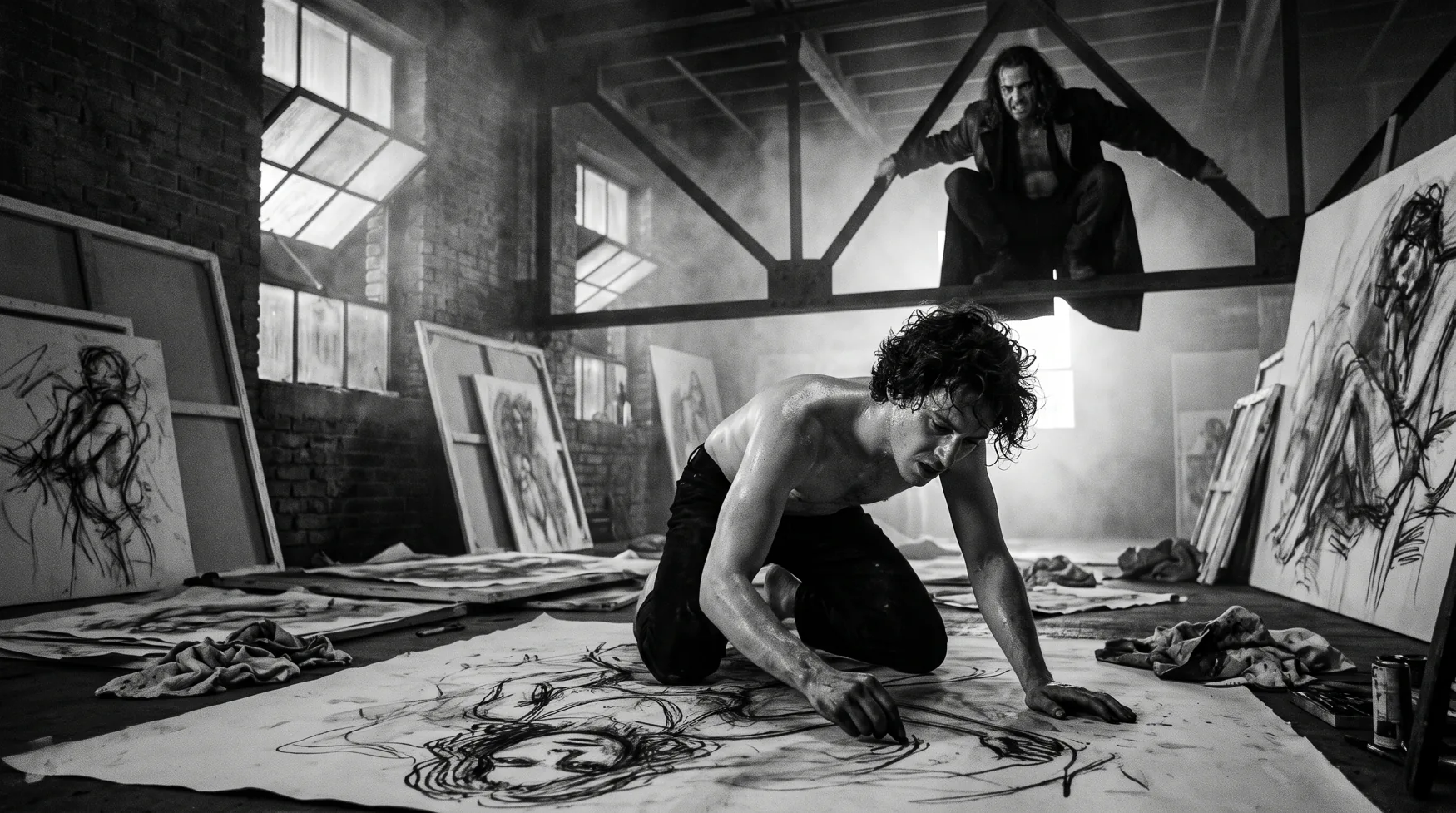
THE MONSTER returns that possibility to the center. Its female image is painted close to completion, imagined as a companion, then erased. The creative method differs; the moral turning point survives.
Back to Mary Shelley’s 1818 text
“I am alone, and miserable; man will not associate with me; but one as deformed and horrible as myself would not deny herself to me.”
What a modern adaptation can reveal
Kenneth Branagh's 1994 Mary Shelley's Frankenstein treats the female body as an emotionally maximal spectacle, culminating in the reanimation of Elizabeth. It is audacious, operatic and unforgettable. But that choice is not the same scene as the one Shelley constructed. In the novel, Victor creates—or begins to create—a female companion for the Creature, then destroys his unfinished work before bringing her to life. The imagined woman never gains a voice, a wish, or even the right to refuse either man. That absence is the entire point of the episode.
The two stories generate different questions. A reanimated Elizabeth makes Victor's romantic loss visible and grotesque. The destroyed companion asks whether men can authorize the existence or nonexistence of a woman on the basis of their own fears. Victor imagines that she might reject the Creature, become dangerous, or reproduce independently of any promise made by her intended partner. He destroys her not because she has done anything, but because he cannot bear what she might choose. This is horror built from speculation about female autonomy.
A filmmaker can reasonably prefer Branagh's grand tragedy. The deeper criticism is that familiar operatic reversals can smother an unfamiliar philosophical provocation. The novel's missing woman is a narrative black hole: everyone discusses her destiny, but the creature-to-be has no opportunity to participate. Her destruction is the violent removal of a possibility. That matters in a contemporary conversation about reproductive control, consent, and who is entitled to design another person's life. It should not be confused with an assertion that Shelley anticipated modern policy debates in exactly those terms.
Damian Wampler's screenplay restores the terrible hesitation: the artist produces a female image, then prevents it from entering the world. The medium of drawing changes the surface of the scene, not its moral structure. A woman exists first as an image made for another man's desire, and her maker cannot allow the image to become a person who might act outside its frame. It is especially apt for a film concerned with the gaze, the beauty of bodies, and the unstable boundary between art and ownership.
Emily Wotherspoon's scholarship on the erasure of women in Frankenstein adaptations offers a framework for why this apparently minor change has large consequences. The goal is not to make every adaptation a courtroom exhibit. It is to see what disappears when a film replaces a question about women's possible freedom with a familiar tragedy about a man's lost lover. The most faithful scene may be the one that refuses to show the woman at all.
Criticism and contemporary context
In Emily Wotherspoon’s research on Elizabeth and Justine, the shrinking space granted to women across adaptations becomes a central artistic problem. That perspective is useful whenever a screen version gives its male creator complexity while leaving the women around him as consequences.
A 2026 article in Adaptation compares screen versions through the Creature’s ethical status. That approach keeps the discussion away from trivia about matching details and closer to the matter of whose experience cinema asks its viewers to understand.
Editorial context. This is original analysis associated with the development of Damian Wampler’s screenplay THE MONSTER, inspired by Mary Shelley’s public-domain novel. Interpretive claims are presented as readings; named films and actors are not affiliated with the project.