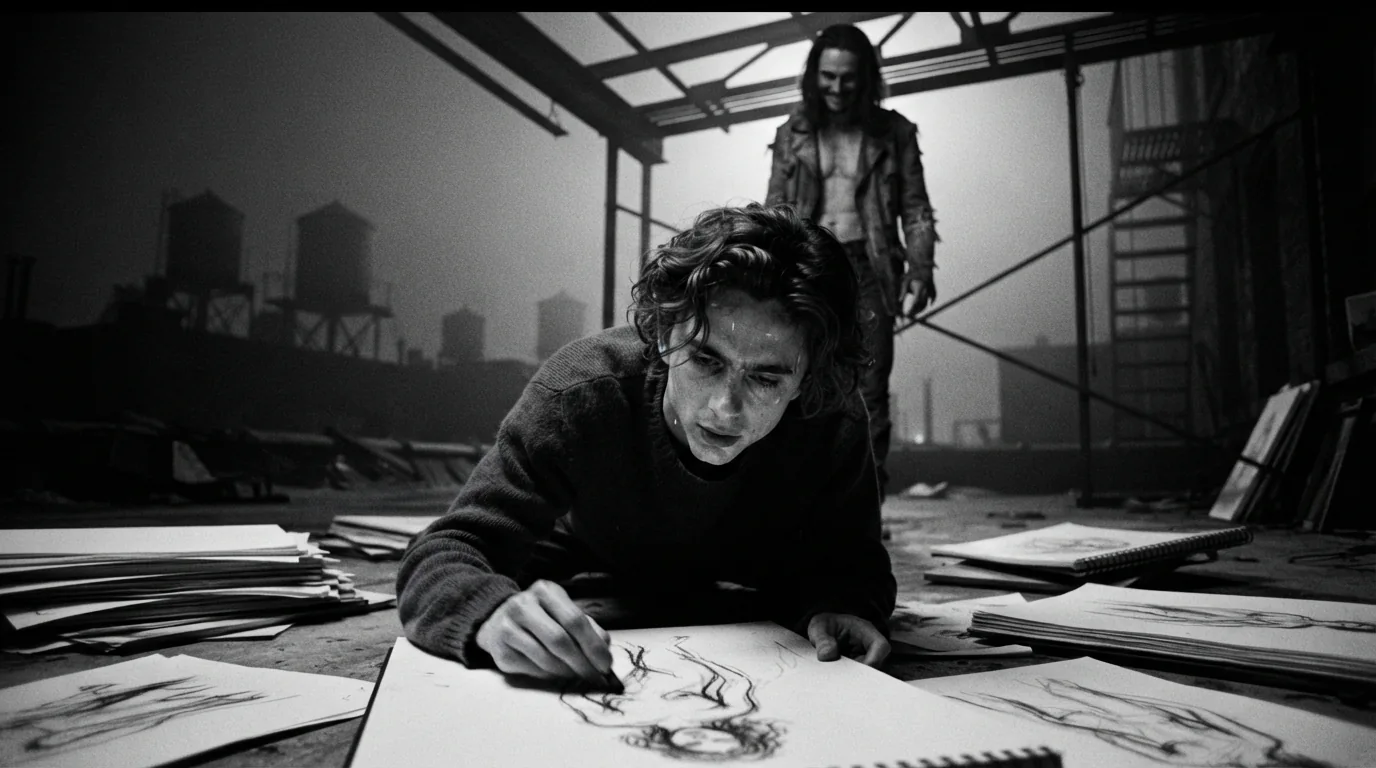
The Creature becomes dangerous, and the novel does not excuse the murders he commits. Yet it insists we witness the sequence that leads to vengeance: a creator who turns away, strangers who react with violence, and an education in human care available only from the shadows.
A compelling adaptation must retain the tension. If the Creature is reduced to a mindless killer, the moral argument vanishes. If he is made completely innocent, the horror becomes frictionless: we are watching a victim rather than a person who makes increasingly catastrophic decisions.
Damian Wampler’s script keeps speed, strength, brutality, and a capacity for longing together. The man walks out of a drawing already longing to be recognized. He also does terrible things. The question cannot be answered by proving him either wholly evil or wholly good.
This tension is the heart of the film: the young man who created life and the being he abandoned can both be responsible, and each can still regard himself as the only wronged party.
Back to Mary Shelley’s 1818 text
“I was benevolent and good; misery made me a fiend.”
What a modern adaptation can reveal
The Creature commits terrible acts, and a morally serious interpretation must not dissolve those acts into pure victimhood. But Shelley's narrative refuses the simpler proposition that a frightening being is evil by nature. He learns affection, imitates kindness, tries to understand other people's lives and becomes violent after sustained rejection. His statement about misery making him a fiend is an argument, not an objective verdict supplied by the author. A film can ask viewers to understand his account while still letting them judge his choices.
This distinction matters because the Creature is often granted empathy only when he appears conventionally sympathetic. A modern handsome design could make the audience's first attachment easier, but that advantage should be used to examine how conditional their compassion actually is. If he begins as beautiful and compelling, what happens when he asks too much, tells an unbearable truth or commits violence? Does the audience withdraw the human status it had been willing to offer him? Beauty can become a test of sympathy rather than its proof.
The Creature's demand for a companion is both moving and coercive. He wants ordinary relational life and believes that creating a partner will make him harmless, but he also threatens the people Victor loves to force a decision. Shelley does not provide an innocent hero in the conventional sense. She gives us a being whose suffering explains but does not excuse what he does. That tension is especially appropriate for a horror film that wants to be emotionally sophisticated rather than merely reassuring.
The scholarly conversation about the Creature includes ethics, social exclusion, class and queer identification. Susan Stryker's work makes the monster a figure through which to explore the politics of being declared unnatural. Other critics examine forms of oppression that precede Victor's scientific transgression. These readings are illuminating without requiring the Creature to serve as a direct stand-in for every marginalized person. His force as a character depends on his unassimilated individuality.
In Wampler's adaptation, the central question may be whether Victor's cruelty is made more visible when the Creature initially looks like someone the audience wants to love. If viewers can be drawn to him, perhaps they will feel more acutely the outrage of his first abandonment and the horror of what he later chooses. The aim is not to absolve the Creature. It is to refuse the comfort of one monster and one innocent man.
Criticism and contemporary context
A 2026 article in Adaptation compares screen versions through the Creature’s ethical status. That approach keeps the discussion away from trivia about matching details and closer to the matter of whose experience cinema asks its viewers to understand.
Susan Stryker’s foundational essay on transgender rage and Frankenstein demonstrates the myth’s power as an artistic vocabulary for a contested body. That does not force a literal identity upon Shelley’s Creature; it shows what later writers can do with the figure.
Editorial context. This is original analysis associated with the development of Damian Wampler’s screenplay THE MONSTER, inspired by Mary Shelley’s public-domain novel. Interpretive claims are presented as readings; named films and actors are not affiliated with the project.