There is another way into Frankenstein and it begins before Victor is old enough to ruin anyone’s life. The early chapters of Shelley’s novel tell the story of Beaufort’s fall into poverty and Alphonse Frankenstein’s arrival as benefactor, husband, and maker of an ordered domestic world. Most adaptations want to get to the Creature. They rush past the social machinery that makes the Creature’s later rejection possible.
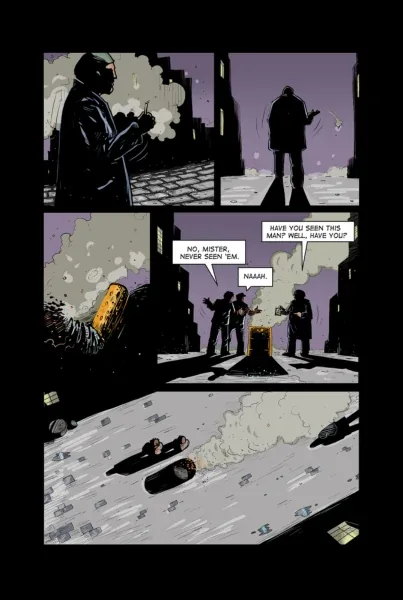
Damian Wampler’s unpublished eleven-page PDF GUTTERS (ten story pages plus cover) returns to that machinery through comics. Its storytelling is visual, urban, shadowed, and suspicious of the romance of rescue. The sequence suggests a prequel that can stand on its own: who was Caroline before she entered the mansion? What debt of gratitude can become a lifetime?
A series adaptation could trace the transmission of an idea: a powerful family imagines itself generous, then its son discovers he can practice the same logic on a being he has personally made. Charity without equality becomes creation without responsibility.
This website features a small, credited preview from GUTTERS. The complete unpublished sample remains available for private industry inquiries rather than being silently distributed in full.
Back to Mary Shelley’s 1818 text
“A new species would bless me as its creator and source; many happy and excellent natures would owe their being to me.”
What a modern adaptation can reveal
A prequel about Alphonse and Caroline is not merely extra material for a franchise. It changes where the audience believes the catastrophe begins. Most Frankenstein stories open with Victor's obsession and treat his family as the world his experiment endangers. Gutters asks what kind of household could produce a Victor who confuses devotion with entitlement and discovery with authority. The narrative shifts the origin from a single forbidden act to a pattern of rescue, class ascent, domestic instruction and inherited expectations. That is not an excuse for Victor; it is a richer explanation of the ideas available to him.
The name Gutters works because poverty is not a decorative backstory. Caroline's early precarity and Alphonse's role as benefactor sit underneath the splendor of the family mansion. A graphic narrative can emphasize the physical distance between those worlds: streets and interiors, fabric and skin, the angle at which someone looks up at a benefactor. The page layout becomes an argument about social rank before anyone makes that argument aloud. The comic and the film can use distinct forms to ask the same question: what is concealed inside an apparently benevolent home?
Shelley's 1818 and 1831 texts complicate even the simplest account of the family, particularly in their treatment of Elizabeth's origins. That is an invitation rather than a nuisance. A modern transmedia project can acknowledge variations openly and dramatize its chosen timeline consistently. The danger is presenting adaptation choices as if they were unambiguous facts of the original. The best accompanying essays invite readers to compare sources, trace changes and see why those changes matter emotionally.
The Gutters pages also provide a proof of tone. Before costly visual effects, the audience can understand the contrast between a carefully composed family image and the economics that brought the family together. They can watch an artist's preoccupation with bodies, status and framing develop as a generational inheritance. That sensibility gives the feature a visual past: Victor does not begin drawing in a vacuum; he grows up in a house where images already perform a great deal of emotional work.
The goal is not to multiply origin stories indefinitely. It is to make the feature's first act feel haunted by decisions that its protagonist never witnessed and cannot readily recognize. That is one of the Gothic form's oldest strengths. The house is beautiful, its occupants believe themselves good, and the foundation contains a history that determines who will be rescued and who will be left outside.
Criticism and contemporary context
The side-by-side discussion of the 1818 and 1831 texts makes the underlying textual choices inspectable. A screen adaptation may select or alter those details, but criticism becomes more persuasive when it names the source version it is using.
Anca Vlasopolos’s study of oppression in Frankenstein provides a critical counterweight to readings concerned only with individual ambition. It helps explain why domestic affection, social position and the right to be believed matter within the horror story.
Editorial context. This is original analysis associated with the development of Damian Wampler’s screenplay THE MONSTER, inspired by Mary Shelley’s public-domain novel. Interpretive claims are presented as readings; named films and actors are not affiliated with the project.