Victor’s first description of his creation emphasizes mismatched features, yellow skin, black hair, and dark lips. These words have attracted scholarship on physiognomy, race-making, colonial fear, and the human tendency to convert an unfamiliar appearance into a moral judgment. But the novel never assigns the Creature a stable modern racial or ethnic identity.
The important cinematic possibility is not to cast the character as an allegory for one group and declare the matter settled. It is to show how an observer invents monstrousness at the moment he chooses not to care. A face becomes strange because Victor fears being responsible for what it expresses.
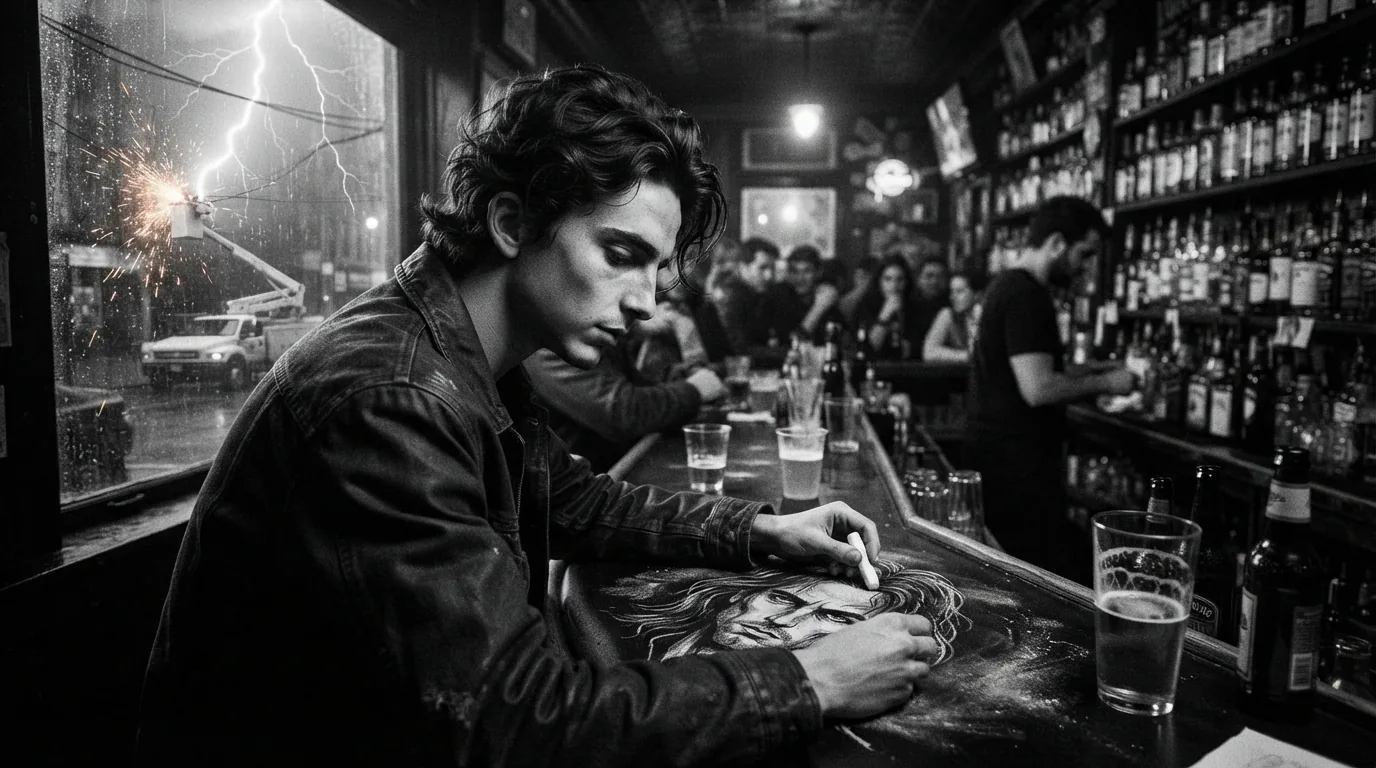
THE MONSTER goes in another direction: its imagined Creature is handsome, physically imposing, and unmistakably male. The horror is not dependent on prosthetics or disgust. He can be beautiful and still be rejected. This opens a conversation about who gets to be seen as beautiful, who gets treated as threatening, and what counts as a person.
Damian Wampler’s version can investigate racialized judgment through Clerval and Justine’s encounters with privilege, without falsely claiming Shelley assigned them those same identities.
Back to Mary Shelley’s 1818 text
“I knew that I possessed no money, no friends, no kind of property.”
What a modern adaptation can reveal
The Creature is not assigned a simple modern racial identity by Mary Shelley's descriptions. His body is marked as different, and other characters respond with shock, aggression and exclusion. Racial readings of the novel can illuminate how bodies become legible as threatening, but they should not confuse analogy with literal classification. The point is not that the Creature “really is” a member of one historical group. It is that social categories determine which appearances are treated as human, which histories count and who is allowed to speak before being judged.
Susan J. Wolfson's work on Frankenstein, race and ethics is a valuable starting point because the novel is saturated with questions of genealogy, property, national belonging and the fear of the unfamiliar. The Creature acquires language and moral reasoning, but none of that earns him an uncomplicated place in society. He has no lineage to invoke, no property to secure his status and no institution committed to explaining his presence. He is visible everywhere and recognized nowhere. This is an uncomfortable mirror of forms of exclusion that cannot be reduced to appearance alone.
Wampler's decision to make the Creature handsome introduces another variable. A beautiful person may be welcomed where a conventionally grotesque one would be expelled, but beauty is not citizenship, a biography, or a guarantee of compassion. The initial welcome can itself become dangerous when people assume that an attractive stranger must have a familiar social history. What happens when he cannot name a mother, an address, a school or an ordinary childhood? The moment fascination gives way to suspicion can reveal how quickly belonging is withdrawn.
Queer and transgender readings also form part of the Creature's critical afterlife. Susan Stryker's 1994 essay explicitly draws on Frankenstein to discuss embodied anger and the politics of being described as unnatural. This is a powerful use of the myth, not a demand that every production illustrate one theory. Film gains from permitting different audiences to recognize different histories of being looked at and rejected. It loses when characters become single-purpose symbols for an issue rather than beings with their own volatile desires.
The novel's crucial ethical transaction is the failure to listen. The Creature can narrate his life and still be refused by the person most responsible for its beginning. A modern film can stage that refusal through familiar institutions—police, family, work, friendship—without claiming that all experiences of exclusion are equivalent. The horror is the ease with which a person becomes a category before anyone asks his name.
Criticism and contemporary context
Susan J. Wolfson’s introduction to Frankenstein, race and ethics broadens the discussion beyond the Creature’s looks. It is important to distinguish historical racial frameworks, the source text’s vocabulary and the deliberate reinterpretations of later readers.
Susan Stryker’s foundational essay on transgender rage and Frankenstein demonstrates the myth’s power as an artistic vocabulary for a contested body. That does not force a literal identity upon Shelley’s Creature; it shows what later writers can do with the figure.
Editorial context. This is original analysis associated with the development of Damian Wampler’s screenplay THE MONSTER, inspired by Mary Shelley’s public-domain novel. Interpretive claims are presented as readings; named films and actors are not affiliated with the project.