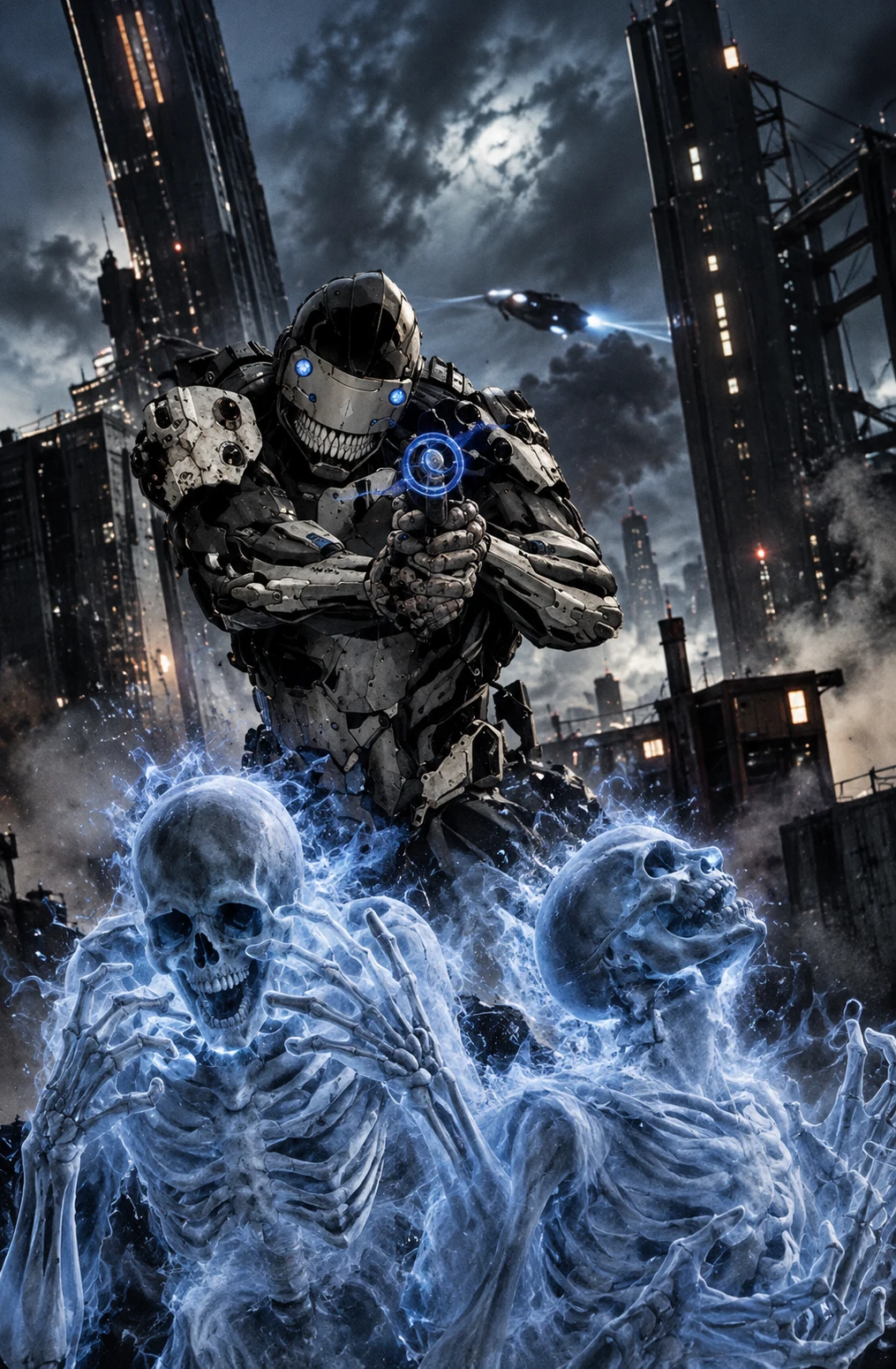
A WORLD BY DAMIAN WAMPLER
MONITOR.
When data is the only currency,
privacy is the only crime.
The award-winning graphic novel.
The feature film in development.
WINNER · 2021Best Graphic NovelPhilip K. Dick Science Fiction Film Festival
SCREENPLAY · 2021Best Sci-Fi Crime ThrillerMiami International Science Fiction Film Festival
TRANSMISSION
The system is watching.
Watch the original MONITOR
graphic-novel trailer.
SEABOARD / THE NETWORK
You enforce the system.
Until it erases you.
Eric is an Axon. His job is to hunt the disconnected. When the network turns against him, the line between protector and prisoner disappears.
Read the world dossierFREE COMIC SAMPLE
Chapters 1 & 2.
31 pages. Yours free.
Written by Damian Wampler.
Published by Broken Icon Comics.
BEST GRAPHIC NOVEL · 2021
A future you can
feel in your bones.
A rogue enforcer. A forbidden disconnection. A world in which your own body can become an instrument of control.
Get the complete first two chapters of MONITOR free: 31 pages covering roughly the first third of the graphic novel. Three more parts continue the story beyond this sample. Discover the award-winning comic Damian Wampler is bringing to the screen.
Two complete chapters · Read online or keep the PDF · No signup required
LOOK CLOSER.
Choose a pageto enter the reader.
Comic illustrations: Elisabeth Mkheidze · Colors: Łukasz Juśkiewicz · Color design: Chunlin Zhao
THE ARCHIVE
There’s more
beneath the surface.
The story. The filmmaker. The wider body of work.
Open a dossier to go deeper.
THE WORLDConnection is compulsory. Freedom is a fault.
MONITOR begins with a bargain that has already been made. Connection offers order, convenience, and belonging. In exchange, the individual becomes legible to a system that never stops watching. In Damian Wampler’s science-fiction graphic novel, data is the only currency and privacy is the only crime. The promise of a connected society has hardened into a command: remain inside the network, or become its enemy.
The country of Seaboard is governed through the Server. Its enforcers, the Axons, pursue people who disconnect. Eric is one of those enforcers until his own relationship with the system breaks. An encounter with a disconnected woman turns an instrument of surveillance into a target. MONITOR follows that reversal through a world of armored bodies, exposed circuitry, controlled movement, and dangerous gaps in the official version of reality.
The opening pages make control intimate before they make it spectacular. A morning routine becomes a sequence of permissions. A body is a site of instruction, correction, and intervention. Even an ordinary impulse can produce a system response. Damian Wampler brings the machinery of the state into the bedroom, then sends the reader out into the city with someone who has learned to mistake obedience for normal life.
That is the central pressure of MONITOR: the network does not merely observe what people do. It shapes what they can do, what they can know, and what they are allowed to imagine. The physical action grows out of a psychological trap. An officer trained to identify threats must reconsider the institution that taught him how to see.
Published by Broken Icon Comics, MONITOR is a completed graphic novel and the foundation for Damian Wampler’s feature-film adaptation in development. The comic remains its own experience: a collaboration of writing, drawing, color, lettering, and design. Its screen adaptation asks how that experience can acquire another dimension through performance, movement, sound, and the uneasy duration of a human face being watched.
FROM COMIC TO CINEMAThe page is the beginning. The screen is the next frontier.
Damian Wampler is developing MONITOR as a feature film, adapting the world of his award-winning graphic novel for the screen. The project brings together two parts of his practice: the freedom to build a speculative world on the page, and the discipline of making that world believable through actors, environments, and cinematic detail. MONITOR is a film in development, not an announced completed feature. The trailer on this site is the original graphic-novel promotional trailer.
A comic lets the eye choose its route. The reader can linger over a panel, revisit an expression, or take in a whole page at once. A film takes responsibility for time. A glance has a duration; a cut withholds or reveals; a voice can contradict the image. Taking MONITOR from graphic novel to movie therefore means more than moving illustrations. It means deciding when the audience knows something, when Eric knows it, and how long the distance between those two moments should hurt.
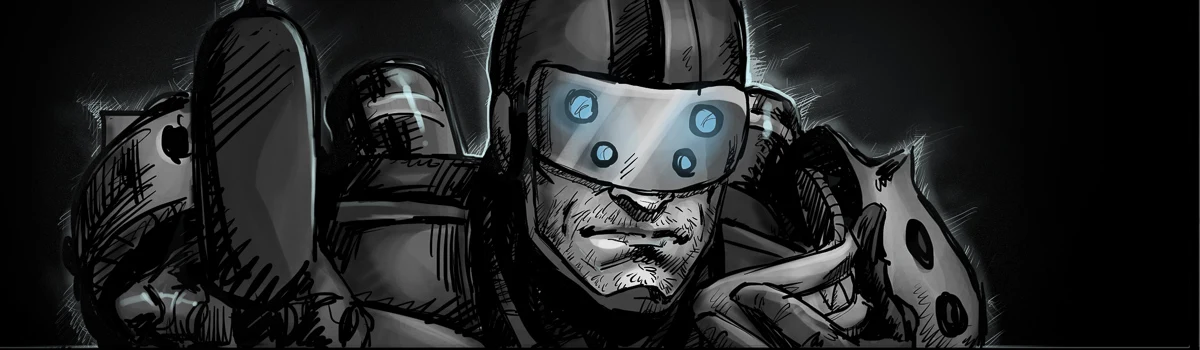
The original artwork offers a visual foundation for that translation. Black gives the world weight. Blue makes technology feel close enough to touch and cold enough to fear. Bodies are divided by armor, architecture, interfaces, and the borders of the panel. In a MONITOR film, those relationships can become blocking, lighting, lens choices, and the sound of systems operating just beyond the frame.
The adaptation also depends on scale. A vast world becomes compelling when it can be understood through a particular person’s problem. An order, an interruption, a refusal, a hand that no longer seems entirely under its owner’s control: these are the places where a speculative premise becomes dramatic. Damian Wampler’s approach to developing MONITOR keeps the audience close to the human cost of its technology.
Wampler comes to that process having written, directed, and produced Written in Skin and First Person Shooter. His experience with short-form filmmaking includes the decisions that continue long after a shoot: editing, sound, color, and the construction of a coherent visual rhythm. MONITOR expands the canvas while retaining that attention to the individual moment.
For collaborators, this archive is an introduction to the underlying material and the filmmaker developing it. The free Chapters 1 and 2 sample presents the comic’s language; the essays describe the artistic context; the credits recognize the people who made the published book. Production and adaptation inquiries can be directed to Damian Wampler through the contact link below. No cast, financing package, production dates, or release date is announced here.
DAMIAN WAMPLERBefore the camera, a blank book.
Before MONITOR, before a film set, there was a blank book. In middle school, Damian Wampler filled one with a science-fiction novella. The blankness was permission: a place could exist because he described it; a person could move through it because he kept writing. At thirteen he began taking photographs. One practice invented worlds. The other demanded that he look harder at the world already there.
Robotech and Warhammer fed an early appetite for imagined civilizations, contested power, and the collision of people with machines. Visits to the Smithsonian supplied another kind of worldbuilding: physical objects carrying the evidence of lives, inventions, and histories. Across science fiction, fantasy, museums, and photography, the attraction was to the same question. What can a constructed world reveal about the people who inhabit it?
Wampler studied English and anthropology at Boston University, later studied geography and the former Soviet Union at the University of Wisconsin–Madison, and earned an MPS in Digital Photography at the School of Visual Arts in New York. Reading Margaret Mead in college helped kindle an interest in Papua New Guinea; years later he would live and work there. Central Asia, the former Soviet Union, and the Pacific became part of an artistic education lived outside the classroom.
His creative path includes a play in New York City, documentary photography, comics, graphic novels, and filmmaking. These forms ask different things of an artist. Theater makes language and bodies share a room. A photograph concentrates attention into an instant. Comics place one moment beside another and invite the reader to bridge the gap. Cinema brings those instincts together with duration, sound, and performance.
Damian Wampler’s published graphic novels include Sevara and MONITOR, both published by Broken Icon Comics. MONITOR received Best Graphic Novel at the 2021 Philip K. Dick Science Fiction Film Festival. His completed short films include Written in Skin and First Person Shooter. Two of his photographic works are held in the Brooklyn Museum’s permanent collection.
As a director and producer, Wampler brings nearly two decades of international leadership and program management to a focused slate of creative projects. The practical work matters: assembling a team, managing resources, making decisions, and sustaining the relationships that carry an idea into production. His artistic work returns to people negotiating identity, power, belonging, and the possibility of choosing another life.
MONITOR sits at the meeting point of those interests. It is a speculative world built by a lifelong science-fiction reader, a visual narrative shaped through collaboration, and a film adaptation being developed by someone who has learned to look closely at how people live inside systems. The ambition is to bring that world to the screen without losing sight of the person inside the armor.
THE PHOTOGRAPHIC EYEGo closer. Stay long enough to see.
Damian Wampler’s photography has taken him beneath a bridge in New York City to photograph people experiencing homelessness; into the life of a Darfur refugee; to an exhibition about orphans in Kyrgyzstan; among Roma communities in Slovakia; and to Chinese road workers in Tajikistan. These are distinct people and places, not interchangeable illustrations of hardship. The common thread is a willingness to approach, listen, and make an image through an encounter.
That work asks for more than access. A photographer decides where to stand, what to include, and what to leave outside the frame. Every choice changes the relationship between a subject and a viewer. Wampler’s interest lies in the individual beyond the label: the gesture that complicates an assumption, the expression that refuses an easy reading, the surroundings that reveal how someone has made a life.
Two of Wampler’s works entered the Brooklyn Museum’s permanent collection. The significance of that destination is also a question about time. An image made in a particular encounter can outlive the circumstances that produced it. It can preserve an expression, a relationship, or a record of a community that a later viewer would otherwise never meet.
The connection to MONITOR is visual as well as thematic. In the graphic novel, the network classifies people and converts them into information. A human encounter resists that reduction. The story’s tension between a person and a system belongs to the same territory as Wampler’s interest in lives that are too often described from a distance.
Photography also provides a working vocabulary for the MONITOR film adaptation. A face against a hard architectural line can tell us who holds power. A small figure within a large environment can make isolation tangible. A cold light can feel institutional; a change in distance can transform observation into intrusion. These are dramatic tools before they are decorative ones.
As Damian Wampler develops MONITOR for the screen, that photographic discipline remains useful: decide what the audience should notice, make the image carry a relationship, and allow the person in front of the lens to be more complicated than the premise. The imagined future acquires weight when its inhabitants feel observed with the same care as people in the present.
VISUAL LANGUAGEBlack is the structure. Blue is the signal.
MONITOR’s published pages establish a world in hard contrasts. Dense black ink organizes the eye. Gray gives bodies, buildings, and equipment their material weight. Electric blue appears as energy, interface, atmosphere, and intrusion. The result is a future whose technology feels embedded in its inhabitants rather than laid over them as decoration.
Elisabeth Mkheidze’s illustrations give the comic its physical vocabulary: armor, movement, facial expression, and the pressure of crowded frames. Łukasz Juśkiewicz’s colors and Chunlin Zhao’s color design help distinguish the human body from the systems passing through it. Damian Wampler’s writing and letters work inside that visual field, where official instructions and private reactions can occupy the same page.
For this site, that language becomes black space, cold blue illumination, and occasional orange accents. Orange marks an invitation to act: watch, read, open, contact. The uncluttered surface allows the imagery to arrive before the explanation. Beneath it, the expandable archive gives the visitor a different pace—a place to read closely rather than keep scrolling past another poster.
The MONITOR film adaptation is an opportunity to develop the visual grammar further. A printed panel has an edge. A film frame has an edge and a duration. The tension may live in what enters the frame, in what remains unseen, or in the moment when a familiar room changes because the light, sound, or point of view has shifted.
Damian Wampler’s work on First Person Shooter deepened his attention to cinematography, color, editing, and sound as interdependent parts of storytelling. For MONITOR, those tools serve a world in which perception is politically charged. The audience should feel the difference between being connected, being watched, and being left alone with a thought that the system cannot approve.
COMPLETED SHORT FILMWritten in Skin — the image that remains after love.
Written in Skin is a short film written, directed, and produced by Damian Wampler. It follows Adama and Eve as they meet to finalize the end of their relationship. The immediate task is practical: papers must be signed. The emotional task is not. Their shared past keeps entering a present that neither woman can make simple.
Eve’s artistic spontaneity and Adama’s more structured life have become part of the distance between them. Their encounter holds the ordinary friction of a separation alongside the memories that make it painful. Glimpses of laughter, celebration, and an engagement interrupt the present, giving the audience access to a relationship that the characters are trying to leave.
The film looks for emotion in physical acts. Adama’s breakdown while changing a tire turns an everyday obstacle into a moment when composure fails. Eve painting over their portrait makes the ending visible without making it easy. The image can disappear beneath paint; the time spent making a life together cannot be removed so cleanly.
Written in Skin was selected for eight film festivals and received two wins. Its emphasis on performance, memory, and the emotional meaning of objects belongs alongside Damian Wampler’s speculative work. A relationship drama and a cyberpunk story can share an underlying question: what remains of a person when the life they understood is taken apart?
For visitors discovering Wampler through MONITOR, Written in Skin shows the intimate end of his range. Its stakes live between two people, inside a room, inside gestures that do not require explanation. That attention to emotional scale is relevant to the development of MONITOR as a film: the future must have room for grief, affection, embarrassment, and attachment if it is going to feel inhabited.
The linked video is the music video and sizzle reel for Written in Skin, with music by Eva Gansinger. It is an introduction to the film’s mood and imagery, not the full short film.
Watch the music video / sizzle reelCOMPLETED SHORT FILMFirst Person Shooter — perception under pressure.
First Person Shooter is a psychological thriller written, directed, and produced by Damian Wampler. Following Written in Skin, it represents a more concentrated exploration of cinematic tension: how a frame can suggest instability, how color can shift the emotional temperature of a scene, and how sound can make the space beyond the image feel present.
Wampler also handled the edit, color, and sound. That continuity between directing and postproduction allows the film’s visual decisions to keep developing after the camera stops. A performance is shaped through its placement beside another image. A pause changes when it acquires a sound. A room can remain physically the same while its emotional character becomes unfamiliar.
The title itself directs attention toward perspective. First person places us inside a viewpoint; shooter carries the language of gaming and action. The short’s psychological-thriller approach makes that relationship between an image and the person interpreting it central to its identity. Visitors can watch the trailer rather than have the film’s turns explained in advance.
For Damian Wampler, First Person Shooter is part of the practical foundation for larger work. Directing a short concentrates the demands of filmmaking: preparing the scene, working with performers, coordinating the shoot, then finding the film’s final rhythm in postproduction. Cinematography, sound, and color are not separate embellishments. They determine what a moment means.
That experience connects directly to the MONITOR adaptation. Both projects invite attention to the relationship between perception and control. MONITOR develops those concerns within a larger speculative world, while First Person Shooter demonstrates Wampler’s interest in making tension felt at the level of a shot, a cut, and a sound. The trailer below opens a separate window onto that work.
Watch the First Person Shooter trailerFEATURE DEVELOPMENTThe Cold Open — a room full of people who know how to perform.
The Cold Open is a feature screenplay in Damian Wampler’s development slate. Its current direction brings psychological horror into an enclosed social world: an invitation-only gathering, a screening, a group of people accustomed to appearances, and the pressure of what an image may reveal. The project makes cinema itself part of the dramatic environment.
A screening asks an audience to sit still and watch. Horror makes that agreement unstable. The room becomes a place where looking has consequences, where the person beside you may know something you do not, and where the story on screen can change the meaning of the people watching it. The Cold Open explores the distance between a public performance and a private history.
The screenplay’s development places particular emphasis on contained locations and an ensemble whose relationships generate tension. A theater, its adjoining spaces, and the movement between them can provide both practical production focus and dramatic confinement. The audience learns a social geography: who belongs, who performs belonging, who is overlooked, and who controls the room.
Damian Wampler’s background in theater and photography feeds that approach. Theater makes entrances, exits, proximity, and silence consequential. Photography makes an image feel like evidence while reminding us that a frame can conceal as much as it reveals. The Cold Open brings those concerns into a feature-length horror setting.
Placed beside MONITOR, The Cold Open reveals a recurring interest in systems of observation. MONITOR imagines a society structured by a network; The Cold Open concentrates attention within a gathering. Both allow questions of power and self-presentation to become physical situations. The scale changes, but the fascination remains: what happens when the version of reality a group has agreed to maintain begins to fail?
The Cold Open is in development. This introduction describes its creative direction without revealing the screenplay’s major turns or implying that a completed film, cast, or release date has been announced.
LITERARY ADAPTATIONSMoby-Dick. Frankenstein. New vessels for old obsessions.
Damian Wampler’s work with adaptation extends beyond MONITOR. Arrowhead reimagines Herman Melville’s Moby-Dick through a comic and a television pilot. Gutters and the film project The Monster engage with Mary Shelley’s Frankenstein. Across these projects, adaptation is a way of moving a story’s central conflict into a new environment and discovering what survives the journey.
Moby-Dick is an extraordinary engine for adaptation because its voyage contains so many competing forces: obsession, labor, authority, friendship, danger, and the cost of following a person who cannot turn back. Arrowhead gives Wampler a way to work with that inheritance across the visual architecture of a comic and the developing structure of a television series. The comic and pilot are creative projects, not a claim of a produced broadcast series.
Frankenstein asks a different set of questions. What does a creator owe the life they bring into being? Who is allowed to belong? At what point does rejection become violence? Wampler’s comic Gutters and film project The Monster revisit that territory through his own storytelling. The Monster remains a film project in development; it is distinct from the completed shorts Written in Skin and First Person Shooter.
The relationship to MONITOR is clear at the level of inquiry. A society can manufacture an instrument and then fear the autonomy of what it has made. A leader can turn a shared mission into a private obsession. A person can inherit a name or a function that becomes impossible to inhabit. These questions cross literary periods because they remain dramatic in the body: someone must obey, refuse, escape, or take responsibility.
For Damian Wampler, a graphic novel and a screenplay offer different tests of the same material. A comic must find its force in the arrangement of images and the spaces between them. A screenplay must create playable action and the conditions for performance. Developing MONITOR from comic to movie continues that movement between forms while preserving the authorship and contributions of the original book’s creative team.
Arrowhead, Gutters, The Monster, and MONITOR belong to a practice interested in stories with room to change shape. Their common ground is not a shared fictional universe. It is an artistic interest in people confronting structures larger than themselves—and in the consequences when obedience ends.
CINEMATIC CONTEXTA conversation with science-fiction cinema.
MONITOR can be approached through a lineage of science-fiction films that make technology a question about power, identity, and the human body. The following comparisons are editorial context for readers and prospective collaborators. They are not casting announcements, endorsements, or claims that the named directors, actors, or studios are involved in Damian Wampler’s MONITOR film adaptation.
Blade Runner (1982), directed by Ridley Scott and starring Harrison Ford, Rutger Hauer, Sean Young, and Edward James Olmos, is a useful point of reference for science fiction built through noir. Its city carries the weight of the story; its investigation unsettles the investigator’s understanding of humanity. For a reader arriving at MONITOR through Blade Runner, the connection is the tension between institutional categories and the complicated lives those categories fail to contain.
Blade Runner 2049 (2017), directed by Denis Villeneuve, features Ryan Gosling, Harrison Ford, Ana de Armas, Sylvia Hoeks, Robin Wright, Mackenzie Davis, Dave Bautista, and Jared Leto. Its scale is inseparable from loneliness. A constructed world becomes emotionally legible through a figure moving inside it. That relationship between architecture and interior life is a productive comparison for MONITOR’s pages and for thinking about Damian Wampler’s adaptation from comic to cinema.
Minority Report (2002), directed by Steven Spielberg, with Tom Cruise, Colin Farrell, Samantha Morton, and Max von Sydow, turns a system’s promise of certainty into a thriller about its authority. It is particularly relevant to MONITOR’s interest in an enforcer whose position within the machinery changes. An institution that seemed objective becomes something the protagonist must question from the inside.
Dark City (1998), directed by Alex Proyas and featuring Rufus Sewell, Jennifer Connelly, Kiefer Sutherland, William Hurt, and Richard O’Brien, makes the city itself part of the mystery. Its concern with constructed reality offers another way into MONITOR: what happens to identity when the environment that appears to explain your life cannot be trusted? The comparison is thematic rather than a promise that the stories share the same mechanics or resolution.
Strange Days (1995), directed by Kathryn Bigelow, with Ralph Fiennes, Angela Bassett, Juliette Lewis, Tom Sizemore, and Vincent D’Onofrio, treats recorded experience as a commodity and a source of danger. Its proximity between technology, desire, and exploitation is relevant to the questions MONITOR asks about data. Information is never only abstract when it comes from a person’s life.
Gattaca (1997), written and directed by Andrew Niccol and starring Ethan Hawke, Uma Thurman, and Jude Law, offers a quieter comparison. Its future sorts people through biological information. The dramatic force comes from an individual refusing the limits that information supposedly proves. MONITOR’s network likewise makes classification consequential, placing the struggle over personal agency inside the larger design of a society.
Ex Machina (2015), written and directed by Alex Garland, features Domhnall Gleeson, Alicia Vikander, Oscar Isaac, and Sonoya Mizuno. Its controlled setting makes observation, permission, and the interpretation of behavior feel dangerous. For MONITOR, it is a reminder that a science-fiction premise can become compelling through carefully staged encounters, withheld information, and a change in who appears to hold power.
Together, these films provide several routes into the conversation around MONITOR: noir investigation, engineered identity, surveillance, the ownership of experience, and escape from a system that claims to know you. Damian Wampler’s graphic novel has its own characters, creative team, and visual language. Its film development belongs in that conversation while pursuing a distinct question: what remains yours when connection reaches all the way into the body?
DIRECTOR & PRODUCERAn imagined world needs a real plan.
Damian Wampler works as a writer, director, and producer. The roles connect imagination to responsibility. A screenplay can begin alone, but a film requires an agreement among people: that the project is worth making, that the plan is credible, and that their time and abilities will contribute to something coherent.
Nearly two decades of international leadership and program management inform Wampler’s approach to producing. He has experience assembling teams across cultures, managing substantial resources, and making decisions when conditions change. In film development, those habits become questions of preparation, communication, priorities, and follow-through.
His creative practice also spans the small decisions that determine whether a scene works. Written in Skin and First Person Shooter required the movement from writing to performance, from production to postproduction, and from a finished film to an audience. His work on First Person Shooter included editing, color, and sound, giving him direct experience of how much a film continues to be shaped after the shoot.
MONITOR introduces a larger development challenge. The graphic novel establishes a world and a visual identity; the proposed movie must turn that foundation into a production that can be made. Scale, character, physical environments, and visual effects need to serve the same dramatic purpose. The development process is where those decisions begin to become concrete.
Wampler is interested in collaborators who bring strong judgment and a point of view. Artists, performers, producers, and technical collaborators contribute more than execution. They can reveal possibilities that were not visible when the project existed only in one person’s head. The published MONITOR is already evidence of that collective process, and its film adaptation will depend on building another creative team.
For professional inquiries about MONITOR, Damian Wampler’s slate, or potential collaboration, use the contact link below. The goal is a useful conversation about the material, the work, and what it would take to bring the next project into the world.
THE CREATIVE TEAMEvery world has its makers.
MONITOR is a collaborative work. The credits below follow the published graphic novel’s credit page.
- Writing & letters
- Damian Wampler
- Illustrations
- Elisabeth Mkheidze
- Colors
- Łukasz Juśkiewicz
- Color design
- Chunlin Zhao
- Editing
- Tim Radecki
- Cover lines
- Drax Gal
- Cover colors
- Nick Wentland
- Letter design
- Sal Cipriano
- Publisher
- Broken Icon Comics
Broken Icon Comics
James Maddox, Chief Editor · Eric Watkins, Director of Ops. · Rob Dumo, Art Director · Nick Wentland, Creative Coordinator.
View the original credit pageRECOGNITION & REFERENCESAwards, reading, and further connections.
MONITOR recognition
MONITOR won Best Graphic Novel at the 2021 Philip K. Dick Science Fiction Film Festival. The MONITOR screenplay also received Best Sci-Fi Crime Thriller at the 2021 Miami International Science Fiction Film Festival. These distinctions refer to the graphic novel and screenplay respectively, not to a completed MONITOR feature film.


Further reading
DEVELOPMENT / PRODUCTION / COLLABORATION
Make contact.
Off the network.
MONITOR is being developed for film by Damian Wampler.
For project and collaboration inquiries: